To recap, in my last post I argued that “AI doctor” is healthcare’s horseless carriage. It takes the existing experience and automates the physician-shaped part of it, when the more interesting question is which parts of healthcare should no longer require a physician at all. I called the alternative patient-operated healthcare.
Dr. Larry Weed, a pioneer in medical informatics and inventor of the SOAP note, spent his career dragging medicine toward rigor, and one of his sharpest complaints was about how we train and license clinicians. We reward them, he argued, for a “core of knowledge,” high board scores, facts retained and regurgitated, rather than a “core of behavior,” the demonstrated and audited performance of care over time. The credential certifies what you knew on exam day. It says almost nothing about how well you perform, year after year, for the person in front of you.
I also mentioned the recent JAMA Perspective by Alon Bergman, Robert Wachter, and Ezekiel Emanuel: they argue that the physician shortage and the rapid rise of capable AI should be treated as a single problem, and that the answer is to license autonomous clinical AI the way we license clinicians. This policy proposal may be making its way to Washington before long, which means the time is now to suggest alternative and complementary solutions.
They’ve correctly identified the regulatory moment (so has Doctronic). Existing frameworks were built for static drugs and locked-down devices, and they fit generative systems poorly. And they’re right that something has to change.
Their proposed framework addresses a workforce-shaped problem, but the more immediate reality is an unregulated patient-need-shaped problem occurring now, at home, outside the domain of most of healthcare.
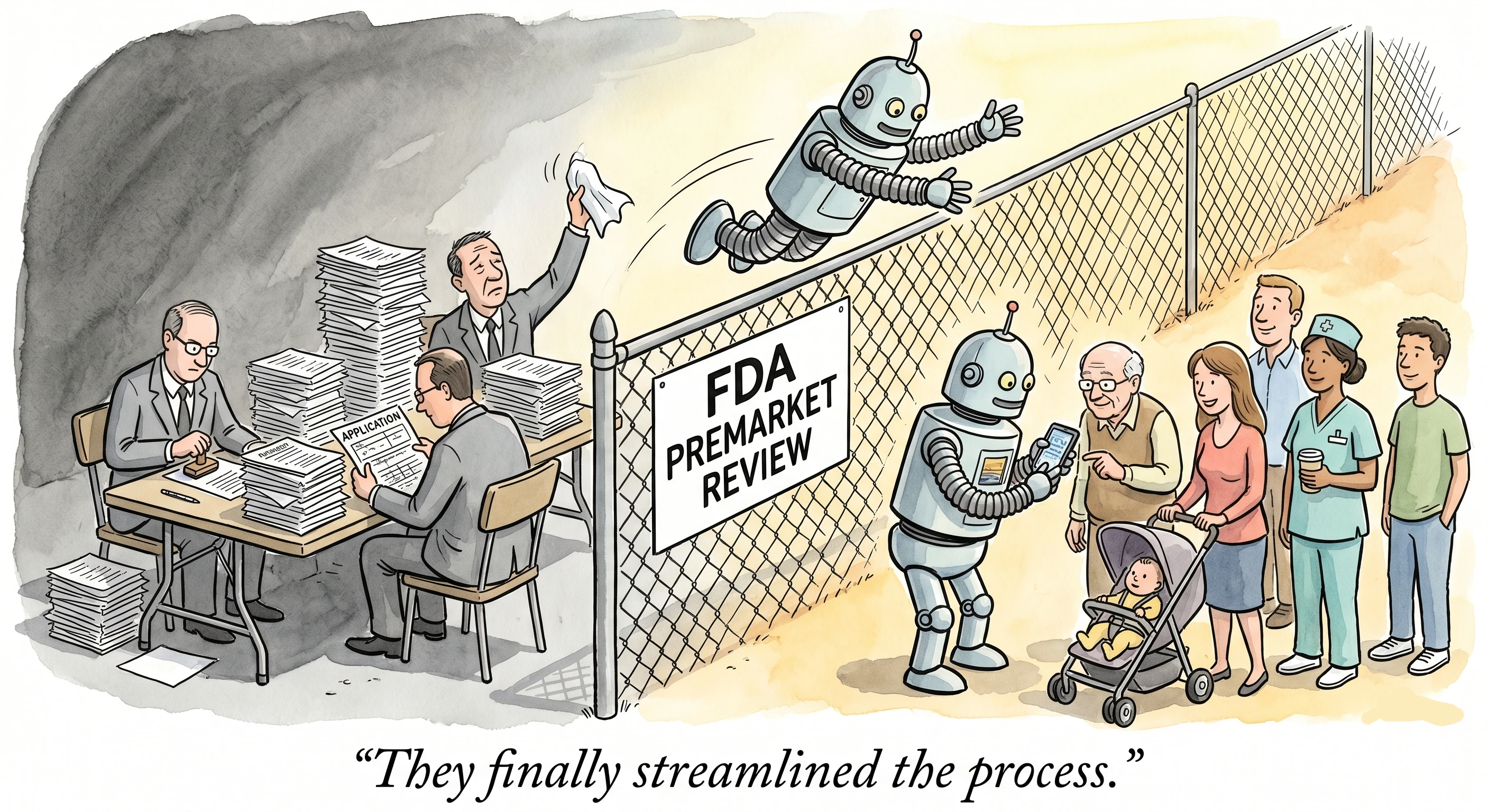
AI has already achieved regulatory escape
A 2026 West Health-Gallup survey found that roughly one in four US adults already use AI for health information, and an estimated 14 million adults reported skipping a provider visit after using AI. Only about 4% of AI health users strongly trusted its accuracy. These people are not AI enthusiasts who think it’s infallible. It’s millions of people acting out of necessity, with open eyes, because the alternative in front of them is worse: a visit they can’t afford, can’t get, can’t take time off for, or can’t tolerate the wait for.
What does a licensing-AI-only approach do for those 14 million people? Nothing. A framework that credentials autonomous AI for deployment inside federally qualified health centers and health systems is a framework built for the institution. It governs the AI that the system points at the patient. It says nothing about patient-directed AI (to borrow a term from Hugo Campos), the unregulated general-purpose model they are consulting at 11pm about their mother’s medication, or the shelf of supplements they bought because it promised the agency the system denied them. The bootleg market doesn’t wait for an Office of Clinical AI Oversight to convene a multi-stakeholder consensus process.
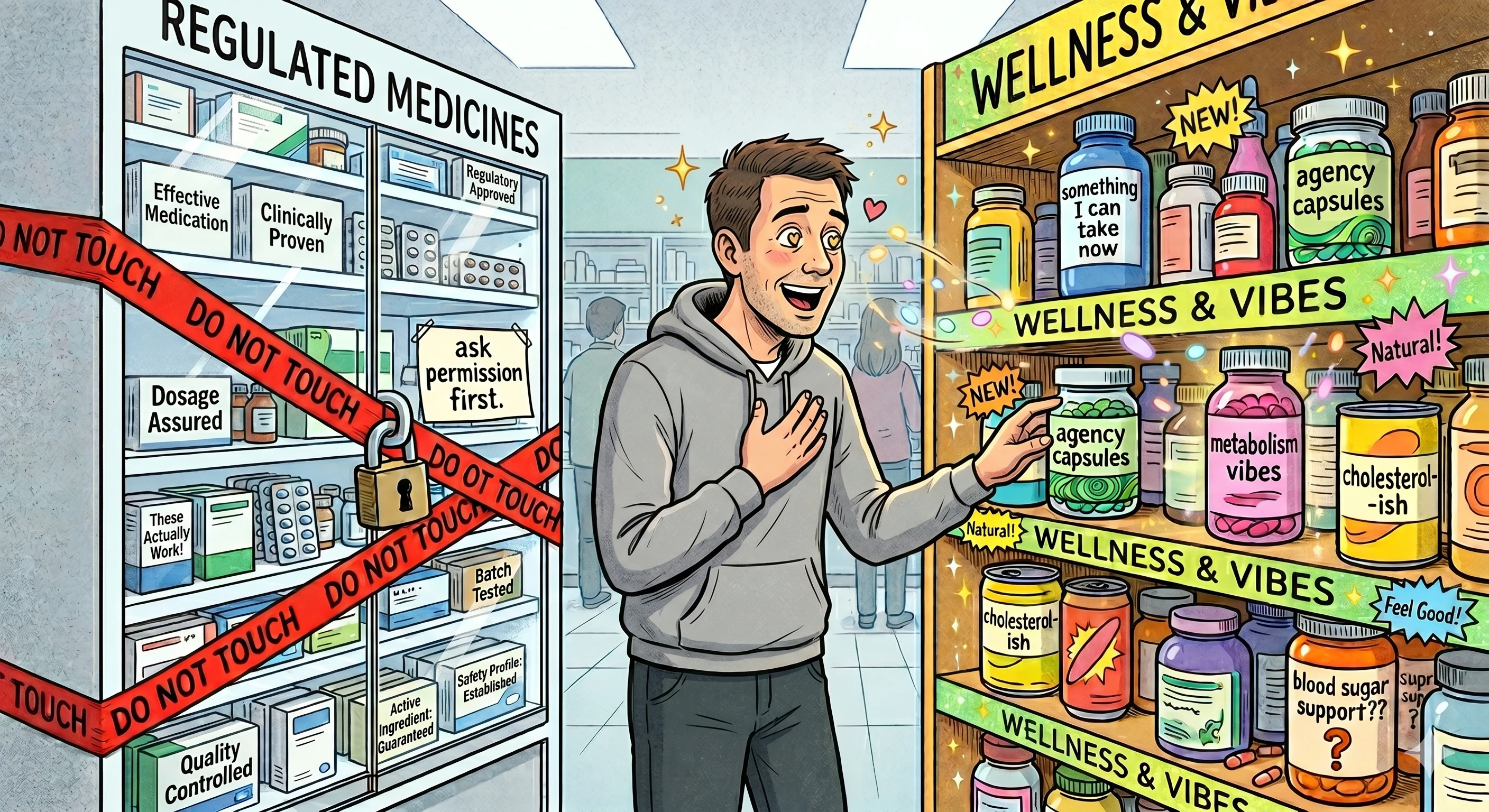
What happens when demand outstrips supply - the lesson of GLP-1s & supplements
We’ve just watched a version of this in real time. When semaglutide and tirzepatide hit the FDA shortage list, compounding pharmacies were permitted to make copies, and millions of Americans got them for $150 to $450 a month against brand-name prices well north of $1,000. Nobody chose the compounded version because they thought it was safer. They chose it because the sanctioned version was unaffordable or unreachable and the compounded one was right there. When the FDA declared the shortages resolved and closed the pathway, many of those people didn’t move to brand-name therapy. They simply stopped.
Pay attention to that sequence, because AI is about to run it at scale. The old bottleneck in healthcare was knowing what you might have. AI has effectively eliminated it; a credible working diagnosis now costs nothing and takes minutes. What AI cannot give you is the confirmatory lab, imaging, or prescription. So the entire weight of demand now presses on those gates, and the GLP-1 episode showed us exactly what forms on the other side of a gate under that kind of pressure.
The more profound example has, of course, been hiding in plain sight for decades: the ubiquitous supplement aisle. A multi-billion-dollar shadow pharmacy, hundreds of thousands of products almost entirely outside FDA premarket regulation, much of it marketed with a wink at conditions we already treat better with prescriptions. Red yeast rice beside the cholesterol section, for people who could be on a statin. Berberine and fish oil for blood pressure and blood sugar. They’re frequently ineffective, inconsistently dosed, and not infrequently contaminated, and people buy them anyway, by the billions, because they promise the one thing the prescription system withholds: the ability to act on your own body without first getting permission. Agency.
This is the age-old law of regulatory escape, and it's the lesson of the last forty years. Refuse people a safe, well-made channel, because it's too expensive, too slow, or too hard to reach, and you don't eliminate the demand. You hand it to whoever will serve it, and what shows up is usually less safe, less effective, and less honest than a deliberately designed pathway would have been.
I’d like to propose an alternative.
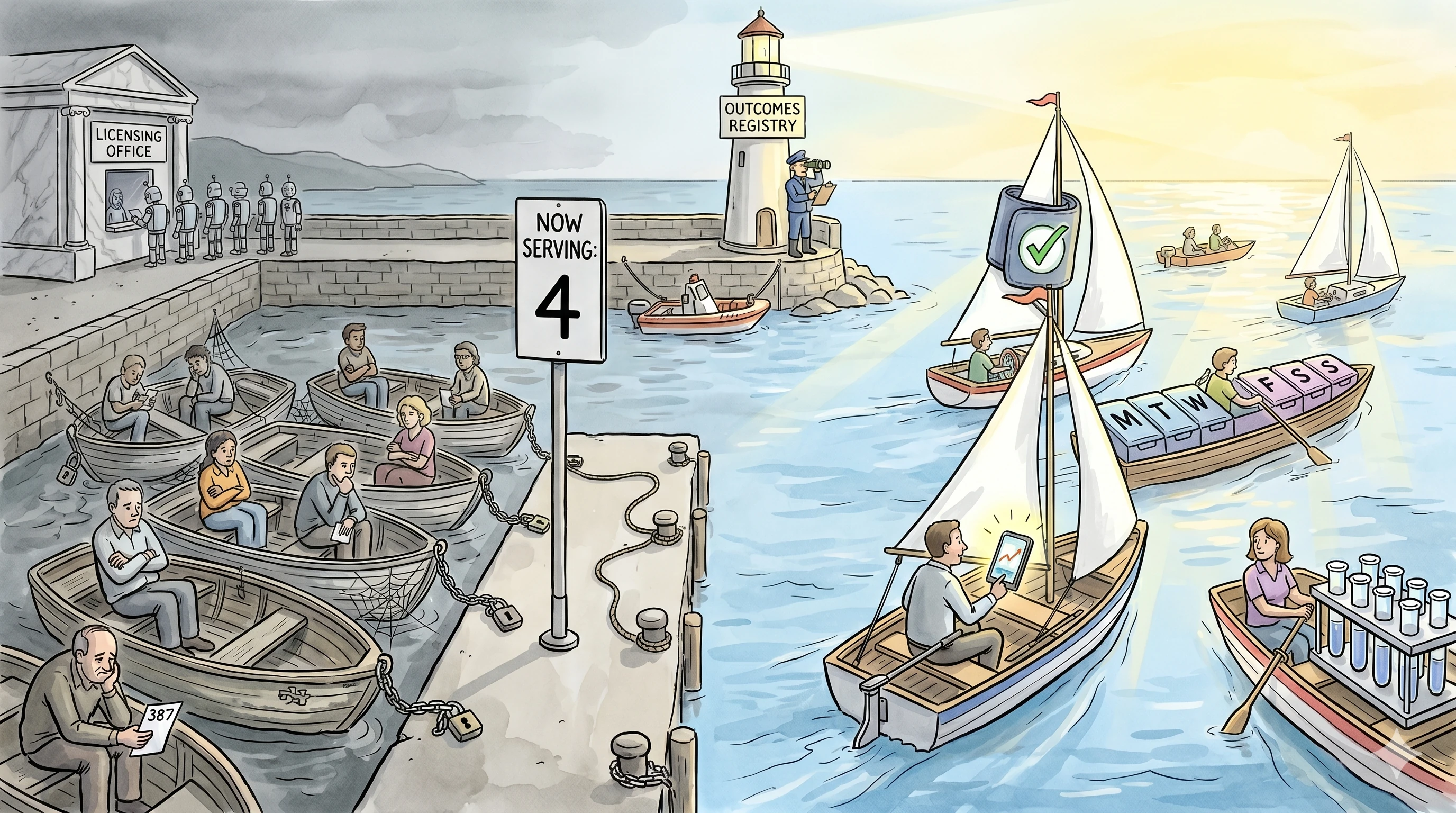
Safe Harbor for Patient-Operated Healthcare
A safe harbor is a defined zone of protected conduct: follow its rules and stay within its boundaries, and activity that would otherwise carry legal liability is shielded. What I’m proposing is a safe harbor for the patient-operated healthcare I described in my last post: an FDA-authorized pathway granting patients and caregivers access to a defined set of low-societal-risk diagnostics and medications, operated with AI support.
Three ideas hold this together.
First: the unit of regulation is access to a class of work, not a credential for an actor. The Bergman framework asks whether the AI is qualified to practice. The Safe Harbor asks a different question entirely: for this specific class of health work, is letting patients operate it, with tools, demonstrably at least as safe as the care they actually get (or don’t get) now? We aren’t certifying an intelligence. We’re authorizing a redistribution of work and then watching, rigorously, to see whether the redistribution holds up.
Second: Permission comes first. Both the FDA device model and the licensure model are fundamentally pre-market. They both ask for proof of competence before the work is allowed, then check in periodically. That cadence won’t keep up with systems that change monthly, and more importantly it leaves the 14 million and growing in regulatory escape completely unprotected in the meantime. The Safe Harbor inverts it. Access is presumed for the defined classes, and the system earns continued access through demonstrated non-inferiority.
Third: safety is established through a registry-based randomized design that members opt into, not condition by condition. The FDA’s existing approach to authorizing patient-facing diagnostics, which is one condition, one device, one indication at a time, will not work for this technology. Every new use would have to be litigated through its own premarket process, which would make authorization slow and prohibitively expensive. The frontier of what patients could do for themselves would crawl at a glacial, application-by-application pace while the technology races ahead. The Safe Harbor can’t work this way or it inherits the same bottleneck wearing a new name.
That’s why the Safe Harbor uses a registry. Patients who choose to operate their own care under the Safe Harbor have to agree to enroll in a registry, and within that registry we run pragmatic randomized comparisons: members are randomized, where it is ethical and feasible, between patient-operated access and usual care, with real outcomes tracked through existing records. This isn’t exotic. Registry-based randomized trials are an established methodology that allow you to generate prospective, real-world evidence at a fraction of the cost and time of a conventional trial, because the registry is both the enrollment mechanism and the data collection mechanism. We’re not running one study. We’re standing up a permanent evidence engine that produces continuous, comparative, prospective data on whether moving a given class of work to the patient helps, hurts, or makes no difference.
The benchmark would be status-quo non-inferiority. Not perfection (arguable that we’ve ever known what this is). Not zero risk. The honest comparator is the real one. The 14 million people skipping visits. The patient who waits eleven weeks for an appointment. The therapeutic inertia that leaves a treatable number untreated for a year. If a patient-operated pathway produces outcomes at least as good as that, and it will often clear that bar easily because - who are we kidding - that bar is on the floor, then the burden of proof shifts to the people who want to keep the gate closed.
Isn’t Utah already doing this?
Sort of, and the difference is instructive. Utah’s Office of AI Policy recently authorized Doctronic’s AI to autonomously renew prescriptions for about 190 chronic disease medications, the first program of its kind. Doctronic’s founders defend it in language I could have written myself: the status quo is the biggest risk, and the honest comparator is the patient who goes without.
The pilot is truly groundbreaking, and I can only celebrate their push for regulatory innovation. What’s so promising is that it proves a regulator can look at the non-adherence numbers and conclude the gate itself is the hazard (I acknowledge “adherence” is a fraught term). But look at what Utah actually built, and you’ll see the licensing model in miniature, not patient-operated healthcare. The state credentialed an actor: the AI is the legal participant in the medical decision, held to physician malpractice standards, validated by demonstrating that it agrees with physicians, 250 reviewed renewals per drug class before autonomy is granted. The benchmark is concordance with the doctor, which quietly re-enthrones the status quo as the gold standard the moment after you’ve argued the status quo is the problem. The patient’s role is unchanged: request and receive.
And the scope tells you who the framework serves. Renewals only, of medications a licensed clinician already initiated. The expensive part, the diagnosis, the initiation, the titration, stays entirely behind the gate. It’s a faster pharmacy window bolted onto the same building.
The structural fragility may be the final lesson. The pilot lives in a regulatory sandbox, in one state, on a 12-month clock, with no randomized comparison, and the state’s own medical licensing board is already campaigning to shut it down. That’s what happens when the frame is “we licensed a machine to do doctor work”: it becomes a turf war between the machine and the profession, fought on the profession’s home field. The Safe Harbor picks a different fight on different ground. It doesn’t ask the medical board to accept a new colleague. It asks whether citizens can be trusted with a broadened class of decisions about their own bodies, and then measures the answer. One of these framings has a natural constituency of 340 million people. The other has a natural constituency of however many companies can fit in a sandbox.
What this actually looks like for a person
Let’s make this concrete, because policy at this altitude is easy to nod along with and hard to feel. Two people, same clinical situation, different systems.
Marcus, in the system we have
Marcus is 54. At a work health screening his blood pressure reads 152 over 96, and a finger-stick total cholesterol comes back high. The screening nurse tells him to follow up with a primary care doctor.
He doesn’t have one. He calls the health plan’s directory; three of the listed doctors aren’t taking new patients, and the one who is has an opening in nine weeks. He takes it. In the meantime his blood pressure is doing what untreated blood pressure does, silently.
Nine weeks later he sees the doctor for fifteen minutes. She’s appropriately cautious about the blood pressure: one elevated reading at a workplace screening isn’t a diagnosis of hypertension, so she doesn’t start a medication. She asks him to buy a cuff, take readings at home over the next couple of weeks, and either send them in or come back so she can confirm before treating. She also orders a lipid panel and a basic metabolic panel and tells him to come back after the labs.
He gets the blood draw the following week. He buys the cuff. He takes a few readings, they look high, but he isn’t sure he is doing it right, there is no easy way to get them to her, and the instruction to “come back” means another appointment he has to find time for. So the blood pressure stays high while he focuses on other things. The lab results post to a portal he can’t quite navigate; his LDL(bad cholesterol) is 190, clearly high, but nobody calls. At a follow-up a month later, she confirms the hypertension from the home readings he finally brings in, starts him on a low-dose statin and an ARB (angiotensin receptor blocker, a common first medication for high blood pressure), and says to recheck labs to make sure the statin isn’t bothering his liver and the ARB isn’t disturbing his potassium and kidney function.
He means to. Life happens. The recheck slides. When he finally gets the repeat panel, four months later, his LDL has come down but is still above goal at 150, which means the dose was never quite enough. His BP is at 142/85, lower, but not at goal. Adjusting both requires another visit, another wait, another fifteen minutes. By the time Marcus is actually at his therapeutic target, more than a year has passed since that screening. For that entire year, his arteries took the full load. Nobody did anything wrong, exactly. The therapeutic inertia was structural. The system was working as designed. That’s the problem.
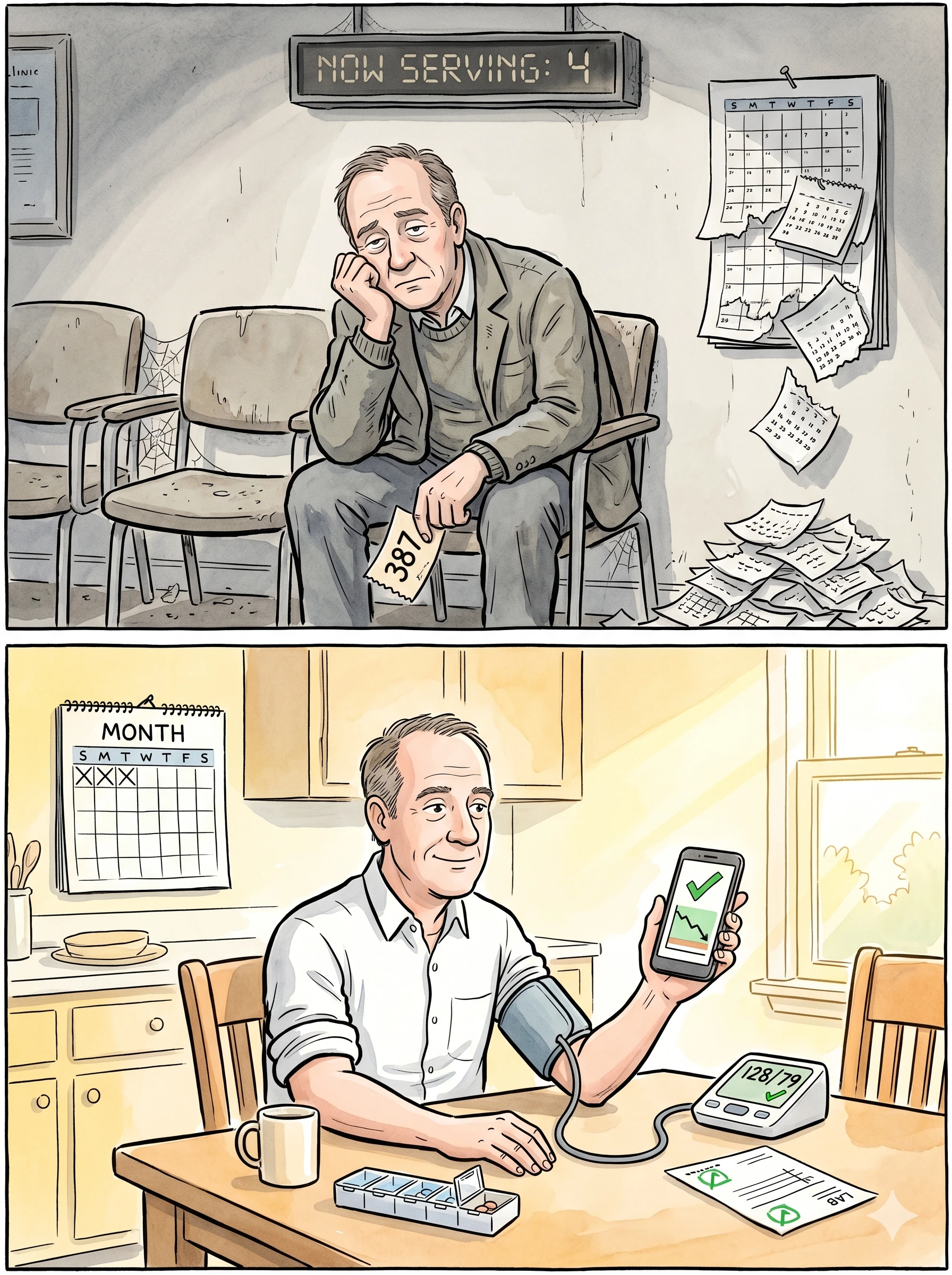
Marcus, operating his own care under the Safe Harbor
Same numbers. Same body. Different infrastructure.
The screening result flows into a patient-operated system on his phone. The system doesn’t pretend to be his doctor. It does something more useful: it tells him, in plain terms, that one elevated reading isn’t enough to start blood pressure treatment, and walks him through confirming it properly, taking home readings over the next week or two with a cuff it helps him use correctly, and logging them automatically rather than leaving them stranded on a slip of paper. The readings come back consistently high, so the diagnosis is confirmed the way it should be, except here the confirmation step actually closes instead of evaporating. It also tells him that two well-understood, low-societal-risk medications, a statin and an ARB, are first-line for exactly his picture, and that under the Safe Harbor he can begin them as a patient-operator, having enrolled in the registry.
For Marcus, this is empowering. In his imagination, this is something he can address quickly on his own.
Before anything is dispensed, the system walks him through what these drugs do, what the real risks are, and the specific things that have to be watched, on their actual schedules: a potassium and kidney function check a week or two after starting the ARB, and a lipid panel with liver enzymes some weeks later to see whether the statin dose is doing its job and being tolerated. This isn’t a checkbox. It’s genuine informed autonomy, and he has to demonstrate he actually understands the monitoring before access opens, the same way the FDA’s Additional Condition for Nonprescription Use rule already contemplates a technology-enabled step that substitutes for the physician’s screening conversation.
He starts both medications within days of confirming his blood pressure, not four months later. The system orders his baseline and follow-up labs on its own authority under the Safe Harbor, on the right schedule for each drug, and routes them to a standard lab he walks into. The early ARB check comes back with normal potassium and stable kidney function, so that stays. When the later lipid panel shows his LDL still above goal, the system does the thing that took Marcus a year and two visits in the other story: it surfaces, immediately, that he is under-titrated, confirms his liver enzymes are fine, explains why, and steps him up to the next statin dose. It also prompts him to check his BP to see if he’s at his BP goal. A flag he cannot dismiss is built in: if the labs had shown a meaningful rise in liver enzymes, or a potassium climbing toward dangerous, the system would stop the patient-operated pathway and route him to a clinician before refilling his meds, because that is exactly the line where embodied judgment under dangerous uncertainty starts to matter.
Marcus reaches his target in weeks, not a year. And here’s the part that makes it policy rather than a nice story: his entire arc, the timing, the labs, the titration, the outcome, is captured in the registry, randomized against members getting usual care, and rolled into a continuous comparison. We’re not asserting this is safer. We’re measuring it, in the open, against the real alternative, which in Marcus’s case was a year of unmanaged risk.
That’s the difference between licensing a machine to be a doctor and licensing a system of measurement to tell us the truth about what patients can safely do.
Could most meds be OTC?
If Marcus mismanages his own statin, the consequences fall on Marcus, and they fall in a domain where we already trust people with comparable decisions every day. Antihypertensives, statins, many routine confirmatory labs, low-risk imaging like a renal ultrasound or a DEXA scan: this will be the territory of patient-operated healthcare, and much of it is honestly overdue. The fear that patients will hurt themselves with these tools deserves a hard look at the actual numbers, because the numbers don’t say what the gate assumes they say.
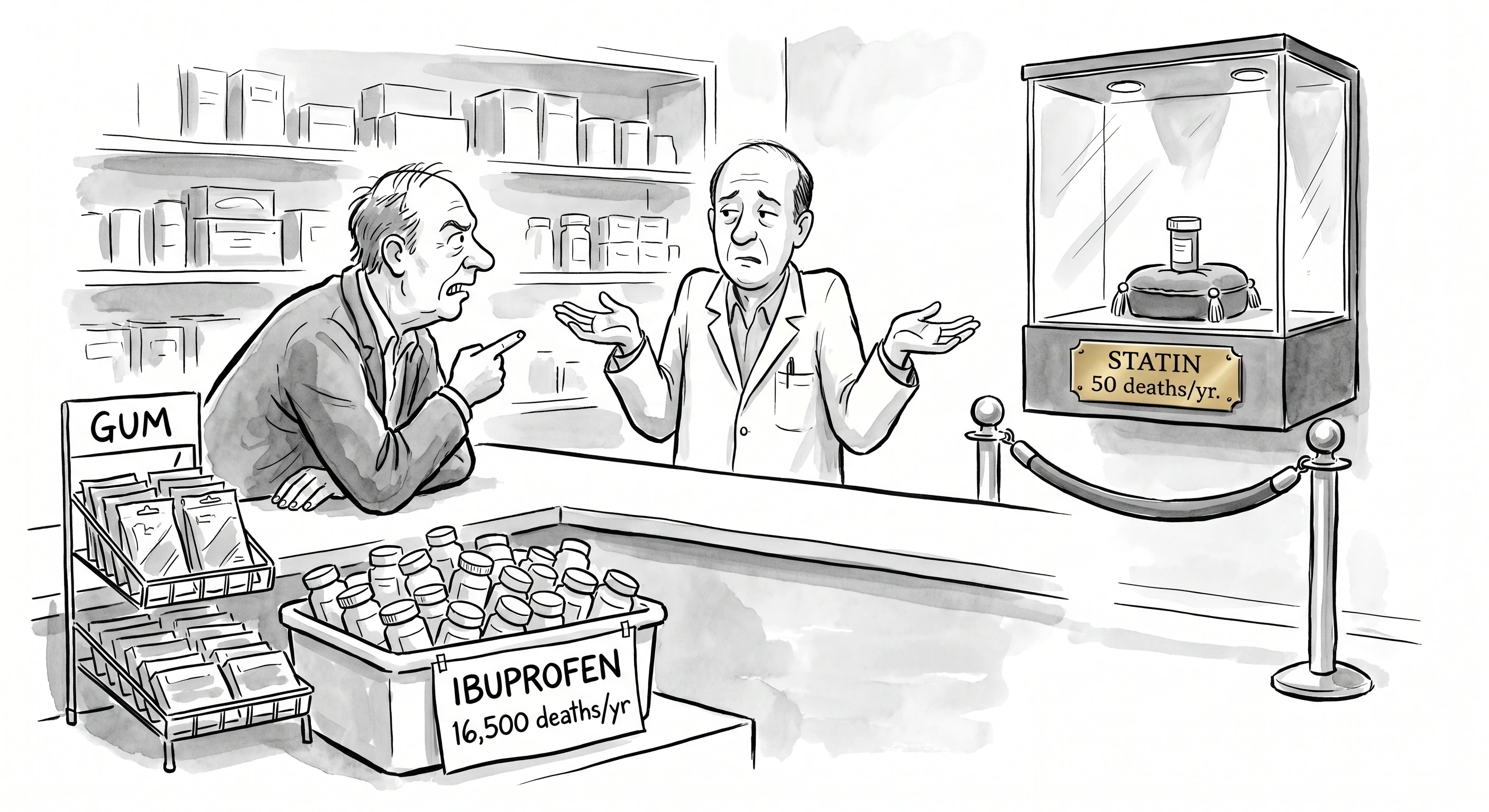
We let people make un-intuitively dangerous decisions for themselves all the time
Start with the things we already let people do without anyone’s permission. NSAIDs, like advil, are tied to something on the order of 16,500 gastrointestinal deaths a year, a figure that comes from older arthritis-population data and has likely declined since, but is still orders of magnitude above recreational risks we shrug at. And the prescription drugs we gate most reflexively aren’t the dangerous ones. Fatal rhabdomyolysis from statins runs around 0.15 deaths per million prescriptions, which against the roughly 330 million statin prescriptions written each year works out to perhaps 50 deaths nationally. We make people see a doctor to get the drug that kills 50 people a year and sell the one tied to 16,500 next to the chewing gum. Whatever logic governs that boundary, it isn’t a risk calculation.
It’s cardboard labels, the advanced safety technology that makes NSAIDs as safe as they are and which, interestingly, were the reason statins never made it OTC. The FDA rejected OTC statins on three separate occasions in the 2000s because, in self-selection studies (the bar for OTC meds), people couldn’t reliably sort themselves into or out of treatment. The tools that enable patient-operated healthcare don’t need to match a physician. They need to beat cardboard.
Now hold those numbers against the risk that almost never gets counted as a risk at all: not taking the medicine. Estimates of death associated with medication non-adherence in the US run to around 125,000 a year, although this is almost certainly a gross underestimate. The CDC has found that cost-related non-adherence raises all-cause mortality by 15 to 22 percent in patients with chronic disease. The direction isn’t in dispute even if the exact body count is. The largest avoidable harm in this whole picture is not the side effect of a drug taken. It’s the drug never started, never refilled, never titrated to target. It’s Marcus losing a year.
And that harm is the default, not the exception. Roughly a fifth of new prescriptions are never filled at all. About half of people on medication for a chronic condition have stopped taking it within a year. A person’s likelihood of sticking with long-term therapy is, in aggregate, close to a coin flip. Half of treatment for chronic conditions fail for reasons that have nothing to do with the drug; if patient-operated healthcare clears that bar, the burden by necessity shifts to whoever wants the gate.
Some work carries higher individual risk but still no real spillover, things like insulin titration (already automated for folks with T1D). That work can be patient-operated, but it may warrant a higher bar of demonstrated performance before access opens, and tighter monitoring with hard clinician hand-offs built in. More agency, more scaffolding.
And some medications, like chemotherapy, which can be lethal or irreversibly harmful if taken improperly, may need to stay prescription-only until we have developed robust infrastructure for patients. To lean on the transit analogy of the previous post, we’ll want to start with giving people access to bicycles and cars before 18-wheelers.
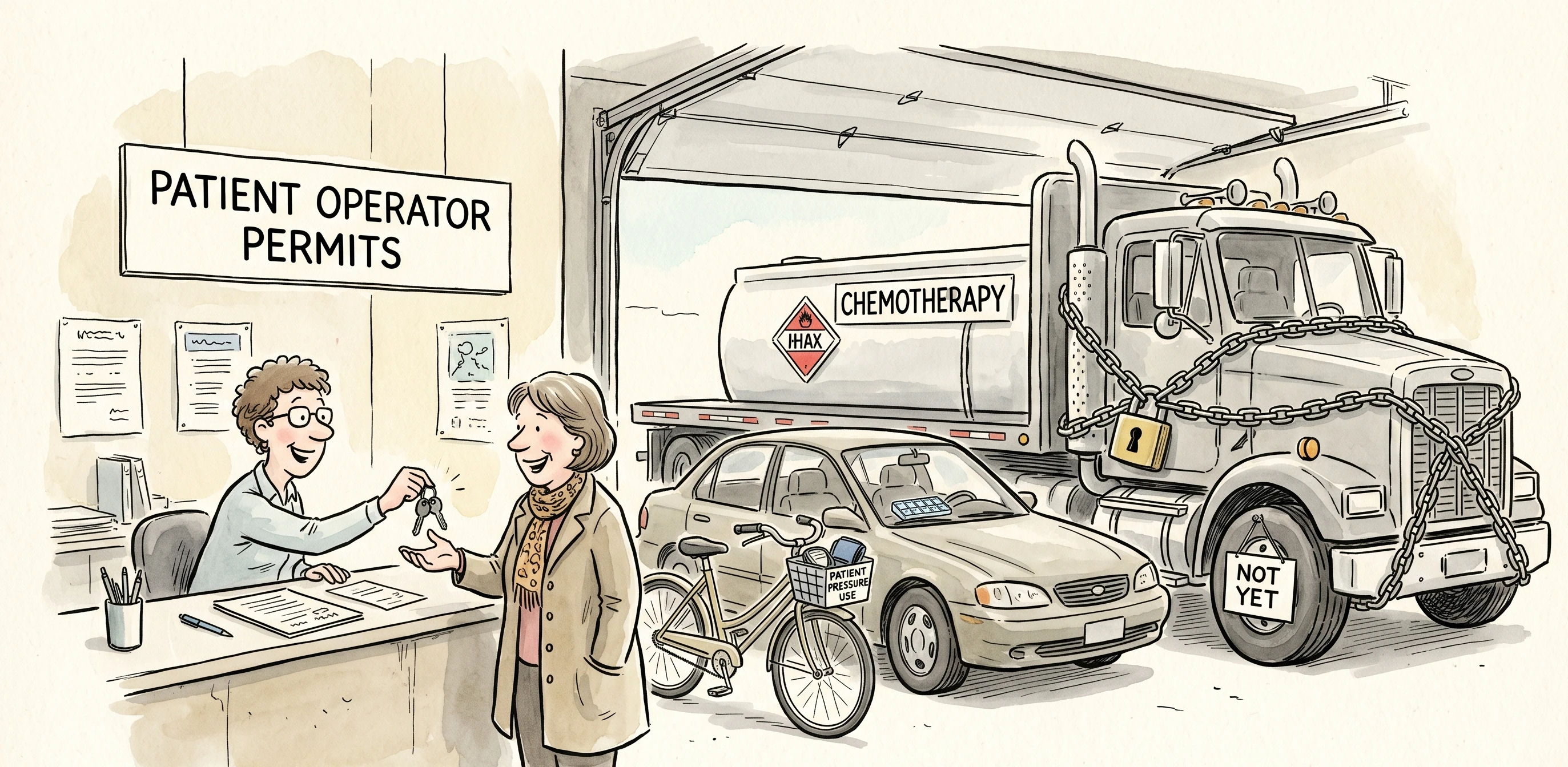
And now the externalities
Some work has to stay gated, not because patients are incapable, but because the worst case falls on people other than the patient. Antibiotic misuse drives resistance that harms the whole population. Controlled substances like opioids should remain controlled, because diversion and addiction reach well beyond the individual.
This is a cleaner principle than the one embedded in the current licensing debate, where the implicit boundary is “whatever currently requires a prescription.” That boundary is an artifact of history and the size of a cardboard label, not a map of actual risk. Externality is the only permanent map.
Now is the time
It’s worth noting plainly that the political winds are blowing in this direction. The current federal health leadership has staked out an unusually strong position on bodily autonomy around vaccines, loosening recommendations and mandates and framing the matter as the individual’s right to choose what goes into their own body. I think they have picked close to the worst possible place to plant that flag. Vaccines are the textbook case of a commons good, where the benefit and the risk both extend well beyond the person making the choice, and the science on that point is not genuinely in dispute. By this externality principle, vaccines sit squarely on the side of the line where collective decision-making is most justified, not least. So I’m not endorsing where this leadership has landed; on the merits I think they have it close to backwards.
But the underlying instinct driving these policy changes, that people should have more authority over their own bodies, is legitimate, and it’s shaping policy right now. It’s creating an opening for patient-operated healthcare that we shouldn’t ignore. An administration inclined to hand people control in the hard, commons-implicating cases should find the easy cases easy. If patient-operated healthcare is ever going to get federal air cover, this may, improbably, be the environment that gives it, and the case for it can be made in exactly the language of individual autonomy this moment is already speaking.
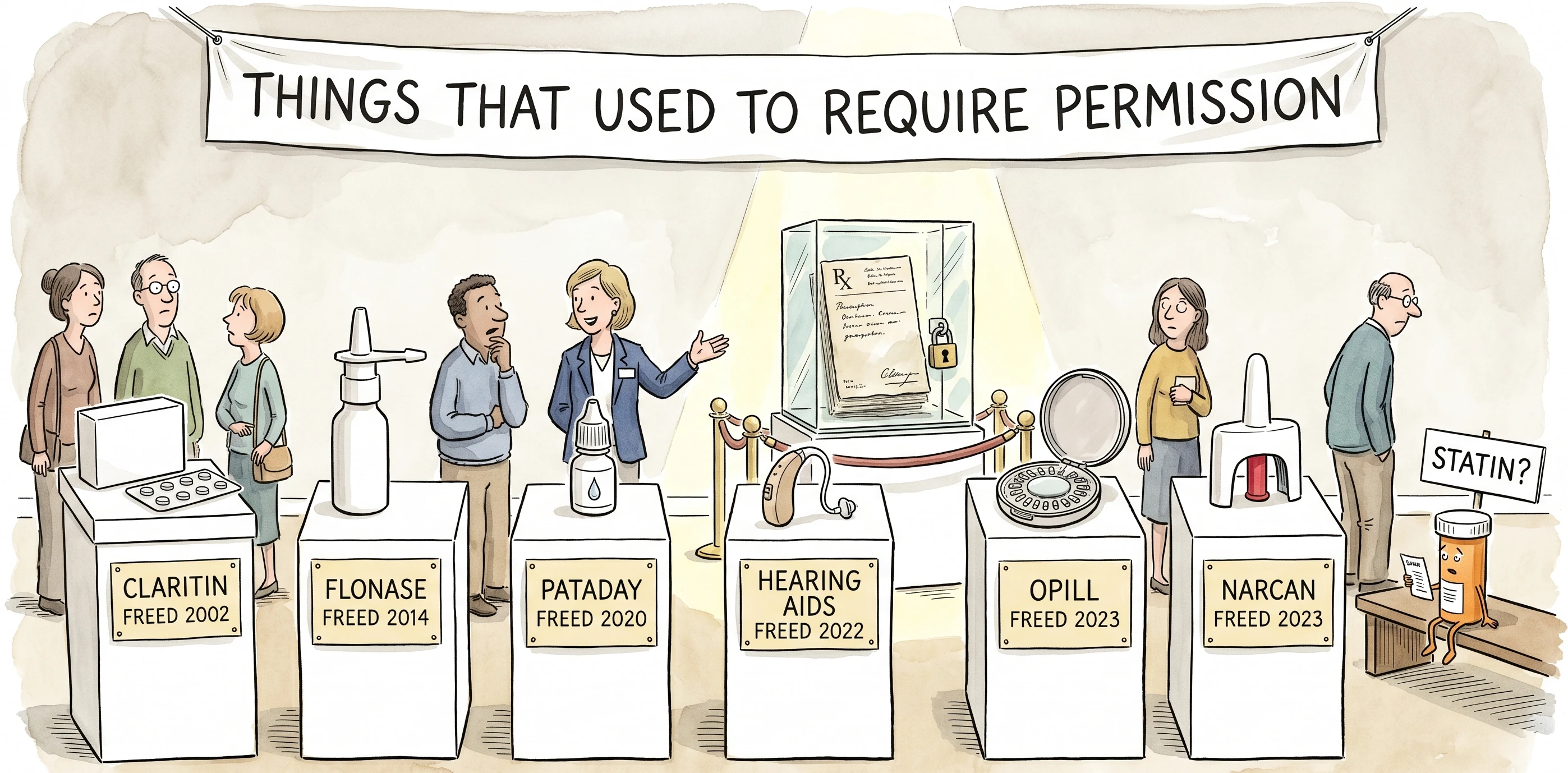
Who runs it, and who pays
I want to be careful not to do the thing I’m criticizing, which is to invent a sprawling new bureaucracy to administer the new idea. The Safe Harbor doesn’t need a credentialing apparatus, because it isn’t credentialing anyone. It needs a comparatively lean function, housed where FDA’s nonprescription authority already lives, to do three things: define the Safe Harbor classes by externality, run the registry and its randomized comparisons, and act on the results, including pulling a class back behind the gate if the data say it isn’t holding up.
This will no doubt require an act of Congress. Presumed access to prescription-class medications, a registry mandate, the authority to capture savings: these probably can’t be conjured by rulemaking alone. The question for Congress isn’t whether to regulate patient-directed AI. That ship has sailed; the tools, most of them not purpose-made, are already in tens of millions of hands. The question is whether to build a measured, audited channel or to keep pretending the unmeasured one doesn’t exist.
Now for who pays. It’s no mystery that keeping the gate closed is staggeringly expensive. Every routine statin titration, every blood pressure med adjustment, every “come back and see me” requires a clinician’s time, an insurer’s claim, and weeks of delay, and we pay for all of it, visit after visit, at clinician prices, to accomplish work that in many cases the patient could have done on their own. It’s ludicrously expensive, and we’ve stopped noticing because the toll is folded into everything.
Opening it generates savings, easily and almost immediately, every time a patient-operated event substitutes for a visit. And so the funding model follows directly: capture a small share of those savings, the way Medicare already captures shared savings in accountable care arrangements, and use it to fund the registry and its audits. The infrastructure that watches the Safe Harbor is paid for by the gate it replaced.
The registry shouldn’t just be about patients. It should be governed by them. Patient-operators should hold real seats in its governance, with the registry run as something closer to a patient data trust than a federal database, deciding how the data is used (including monetized) and who gets access to it. People who take on the work of operating their own care shouldn’t then become the raw material of an evidence machine they have no voice in. If the premise of this whole framework is sovereignty, the institution should be built out of it, not merely aimed at it.
To be clear, accountability has to be explicit, just as it does in the licensing model. Patients who opt into operating their own care accept genuine informed autonomy: if the system correctly raises a red flag and the patient overrides it, the patient has assumed that risk, the way we already let competent adults assume risk in countless other domains. That’s not a loophole. It’s the foundation of treating people not as compliance targets, but as sovereigns.
Michael Turken, MD, MPH is a practicing internist at UCSF and the founder of My Doctor Friend. The usual disclosure applies: he has a financial interest in a company building patient-operated infrastructure, and the irony of the company’s name is not lost on him.
Suggested Reading
The licensure proposal
Bergman A, Wachter RM, Emanuel EJ. “A Licensure Framework for Autonomous Clinical AI.” JAMA. 2026;335(20):1751–1754. https://jamanetwork.com/journals/jama/article-abstract/2848378
Bergman A. “AI doctors should be licensed. Here’s a framework to do that.” STAT, May 11, 2026. https://www.statnews.com/2026/05/11/ai-doctors-licenses-utah-doctronic-pilot/
Larry Weed
Weed LL, Weed L. Medicine in Denial. CreateSpace, 2011. https://www.amazon.com/Medicine-Denial-Lawrence-L-Weed/dp/1456417061
“Remembering Larry Weed, M.D.” Vermont Medicine, Larner College of Medicine, University of Vermont. http://www.med.uvm.edu/vtmedicine/remembering-larry-weed-m-d
Mehta N, Devarakonda MV. “An Alternative Paradigm for Evidence-Based Medicine: Revisiting Lawrence Weed, MD’s Systems Approach.” The Permanente Journal. https://www.thepermanentejournal.org/doi/full/10.7812/TPP/16-147
The Gallup survey
“Americans Turning to AI to Supplement Healthcare Visits.” Gallup / West Health Center on Healthcare in America, April 2026. https://news.gallup.com/poll/707789/americans-turning-supplement-healthcare-visits.aspx
“Millions of Americans Now Consult AI Before, After, and Sometimes Instead of, Seeing a Doctor.” West Health, April 15, 2026. https://westhealth.org/news/millions-of-americans-now-consult-ai-before-after-and-sometimes-instead-of-seeing-a-doctor/
GLP-1 shortages and compounding
FDA. “FDA clarifies policies for compounders as national GLP-1 supply begins to stabilize.” https://www.fda.gov/drugs/drug-alerts-and-statements/fda-clarifies-policies-compounders-national-glp-1-supply-begins-stabilize
“FDA Moves to Permanently Close the Door on Compounded GLP-1s.” Pharmacy Times. https://www.pharmacytimes.com/view/fda-moves-to-permanently-close-the-door-on-compounded-glp-1s
Utah / Doctronic
Utah Office of Artificial Intelligence Policy. “AI Doctronic” pilot page. https://commerce.utah.gov/ai/regulatory-relief/authorized-ai-pilots/doctronic/
Doctronic AI Regulatory Mitigation Agreement. https://ai.utah.gov/agreements/doctronic/
“Utah Medical Licensing Board urges state to shut down Doctronic AI prescribing pilot.” Fierce Healthcare. https://www.fiercehealthcare.com/ai-and-machine-learning/utah-medical-licensing-board-urges-state-shut-down-doctronic-ai-prescribing
NSAID-related deaths
Wolfe MM, Lichtenstein DR, Singh G. “Gastrointestinal Toxicity of Nonsteroidal Antiinflammatory Drugs.” N Engl J Med. 1999;340:1888–1899. https://www.nejm.org/doi/abs/10.1056/NEJM199906173402407
Statin rhabdomyolysis risk
Staffa JA, Chang J, Green L. “Cerivastatin and Reports of Fatal Rhabdomyolysis.” N Engl J Med. 2002;346:539–540. https://www.nejm.org/doi/full/10.1056/NEJM200202143460721
FDA rejection of OTC statins
O’Riordan M. “Strike Three: Expert FDA Panel Again Says No to Over-the-Counter Lovastatin.” Medscape, December 14, 2007. https://www.medscape.com/viewarticle/567510
Public Citizen. “Testimony on the Public Health Dangers of Making Lovastatin (Mevacor) Available Over-the-Counter.” https://www.citizen.org/our-work/health-and-safety/testimony-public-health-dangers-prescription-otc-switch
Medication non-adherence
Viswanathan M, et al. “Interventions to Improve Adherence to Self-administered Medications for Chronic Diseases in the United States: A Systematic Review.” Ann Intern Med. 2012;157:785–795. https://www.acpjournals.org/doi/10.7326/0003-4819-157-11-201212040-00538
Van Alsten SC, Harris JK. “Cost-Related Nonadherence and Mortality in Patients With Chronic Disease, 2000–2014.” Prev Chronic Dis. 2020;17:200244. https://www.cdc.gov/pcd/issues/2020/20_0244.htm
Tamblyn R, et al. “The Incidence and Determinants of Primary Nonadherence With Prescribed Medication in Primary Care: A Cohort Study.” Ann Intern Med. 2014;160:441–450. https://www.acpjournals.org/doi/10.7326/M13-1705
Sabaté E, ed. Adherence to Long-Term Therapies: Evidence for Action. World Health Organization, 2003. https://apps.who.int/iris/handle/10665/42682
The Safe Harbor’s mechanics
Lauer MS, D’Agostino RB. “The Randomized Registry Trial: The Next Disruptive Technology in Clinical Research?” N Engl J Med. 2013;369:1579–1581. https://www.nejm.org/doi/full/10.1056/NEJMp1310102
FDA. “FDA issues final rule to broaden types of nonprescription drugs available to consumers” (the ACNU rule), December 23, 2024. https://www.fda.gov/drugs/drug-safety-and-availability/fda-issues-final-rule-broaden-types-nonprescription-drugs-available-consumers
Originally published on Sovereign Care on Substack.