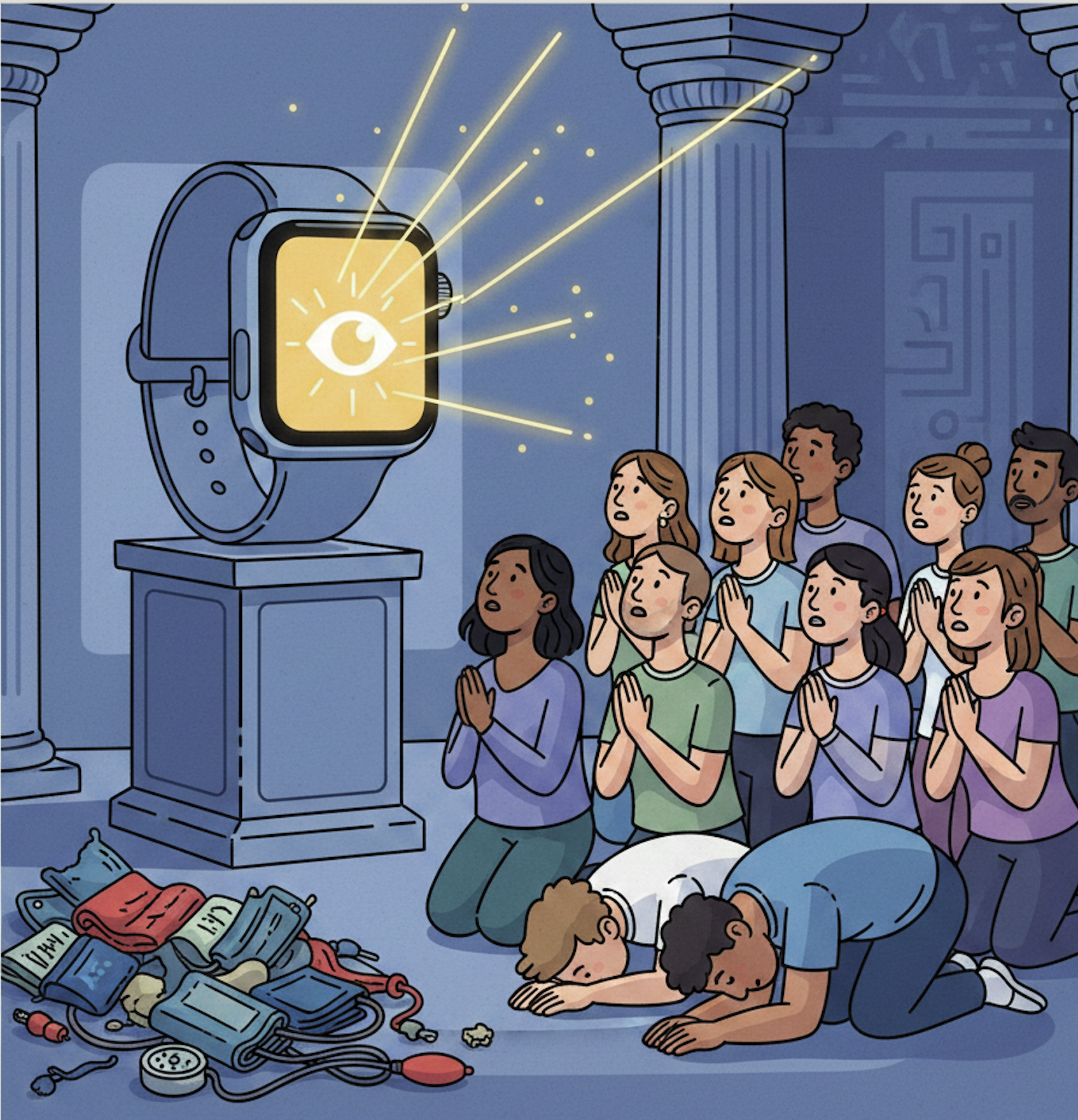
We just launched a new feature: you can now connect your Apple Health data to My Doctor Friend. That means your heart rate, step count, sleep patterns, heart rate variability, and more can flow into the app and give both you and your AI health co-pilot a richer picture of your health over time.
I'm genuinely excited about this. As a practicing urgent care physician, I've seen firsthand how wearable data can help people stay connected to their health between visits. When someone notices their resting heart rate creeping up over a few weeks, or sees that their sleep has been fragmented since starting a new medication, that's real, useful information. To the extent that wearing a device motivates you to walk more, take the stairs, or get outside, that's a clear win.
There's also a frontier here we're only beginning to understand. Heart rate variability, for example, can be an early signal that something is off, sometimes before you even feel sick. Researchers are still mapping the full potential of continuous wearable data, and I believe we'll look back in ten years amazed at what we missed in these early signals.
But I'd be doing you a disservice if I only told you the optimistic story. As someone who worked on wearable health devices at Google, including on the Fitbit teams, I also know where these tools fall short. And some of those shortcomings matter a lot more for certain people.
Don't let your wrist distract you from what matters most
Before we talk about wearable accuracy, I want to raise something that doesn't get said enough: the marketing of wearable devices can be subtly deceptive. Not because the data they collect is fake, but because their job is to convince you that what matters most are the things they can measure on your wrist or your finger. HRV scores, VO2 max estimates, sleep stages, recovery readiness. People get very excited about these metrics.
Meanwhile, many of those same people don't know their average blood pressure. They haven't had their cholesterol checked recently. They've never had their A1C tested, which screens for diabetes and prediabetes. These are among the most powerful predictors of cardiovascular disease, stroke, and early death that we have in medicine, and they require nothing more than a blood pressure cuff and a basic blood draw.
I'm not saying wearable data is useless. I'm saying the hierarchy of what actually predicts your health outcomes doesn't align with what gets marketed to you. If you're spending $400 on a smartwatch but haven't seen a doctor for routine labs in three years, you're optimizing in the wrong order. Get the basics. Then layer on the wearable data. That's the approach My Doctor Friend is built to support.
Not all wearables are created equal
Here's something most people don't know: the heart rate sensor on your wrist works by shining light into your skin and measuring the light that bounces back. The pattern of reflected light changes with each heartbeat as blood pulses through your vessels. It's clever technology called photoplethysmography, or PPG.
The problem is physics. Melanin, the pigment that determines skin tone, absorbs light. The more melanin in your skin, the less light bounces back to the sensor, and the fainter the signal your device has to work with. At rest, most devices can compensate. But during exercise, when you're moving and your heart rate is climbing, the combination of motion artifacts and a weaker signal can cause real problems.
How big are those problems? The research is striking. One study found that for people with darker skin tones exercising at moderate-to-high intensity, a popular fitness tracker produced heart rate errors of over 16 bpm, more than four times the error seen in people with lighter skin.[^1] In another study comparing four devices against a 12-lead ECG, one tracker's accuracy at high heart rates was literally worse than chance, while Apple Watch maintained a non-significant mean difference of just 1.2 bpm.[^2] And in a study of the Apple Watch Series 9 specifically, heart rate correlations went negative for participants with the darkest skin tones during exercise, meaning the device's readings moved in the opposite direction from reality.[^3]
This isn't a small technical footnote. If you're someone with cardiovascular disease using your device to stay within a safe exercise range, the American Heart Association recommends keeping your heart rate about 10 bpm below the threshold where you experience symptoms. An error of 16 bpm, especially one that tends to underestimate your actual heart rate, could mean exercising in a danger zone while your device tells you everything is fine. And the populations most affected by these inaccuracies, Black and Hispanic individuals, are the same populations at highest risk for cardiovascular disease.[^1]
Why I recommend Apple Watch
Not all devices are equally affected. Across multiple studies, Apple Watch consistently performs better across skin tones than other consumer wearables.[^2][^4][^5][^6] This likely comes down to engineering investment: more sensors, stronger light sources, additional infrared sensors that penetrate deeper than green light, and better algorithms for boosting signal when it starts to drop. In one large study of 231 children across all Fitzpatrick skin types, Apple Watch actually outperformed research-grade devices in predicting physical activity energy expenditure, while Fitbit performed worst across every metric, a difference the researchers attributed specifically to Fitbit's less accurate heart rate estimation.[^4] The most recent data confirms this pattern: a January 2026 study of 58 Hispanic adults with Fitzpatrick III-V skin found that Apple and Garmin devices had the lowest error rates during cycling exercise, while Fitbit and Samsung showed significantly greater inaccuracies. Both higher BMI and darker skin tones were associated with increased error across all devices, but the gap between brands was substantial.[^6]
Does this mean Apple Watch is perfect? No. I wear one myself, and there are still moments on the treadmill when it can't keep up. But the gap between Apple Watch and other devices is significant enough that I routinely recommend it to my patients, especially those with darker skin tones who want to use heart rate data for fitness or health monitoring.
If you're using a different device, that doesn't mean your data is useless. Step counts and activity tracking don't rely on PPG and are generally reliable across devices. But if heart rate accuracy matters to you, the device you choose matters too.
A note on pulse oximeters
The same physics apply to pulse oximetry, those little clips that measure your blood oxygen level. During COVID, millions of people bought over-the-counter pulse oximeters to monitor themselves at home. What most didn't know is that these devices can give falsely reassuring readings for people with darker skin, showing normal oxygen levels when they were actually dangerously low.
This isn't a theoretical concern. A landmark 2020 study in the New England Journal of Medicine found that Black patients in the ICU experienced occult hypoxemia (dangerously low oxygen that the pulse oximeter missed) at nearly three times the rate of white patients.[^7] Research published in February 2025, also in the NEJM, confirmed this bias extends to children: the POSTer-Child study tested two common pulse oximeters on 320 pediatric patients and found both devices overestimated oxygen levels in children with darker skin by 1.3 to 1.9 percentage points, enough to mask clinically important drops in oxygen.[^8]
The FDA has acknowledged this problem and in January 2025 proposed updated testing requirements for pulse oximeters, including the use of the Monk Skin Tone scale and more diverse study populations during device approval.[^9] That's a step in the right direction, but it will take years for new standards to reshape what's already on the market. In the meantime, if you use a pulse oximeter, know that the reading may be less reliable depending on your skin tone, and don't let a "normal" number override how you actually feel. If you're short of breath, lightheaded, or just feel wrong, seek care regardless of what the device says.
Your body is a sensor too
Here's something I do almost every time I exercise, even though I'm wearing an Apple Watch: I check my own pulse.
It takes about 15 seconds. Place two fingers (your index and middle finger, not your thumb) on the inside of your wrist, just below the base of your thumb. Press gently until you feel the beat. Count the beats for 15 seconds and multiply by four. That's your heart rate.
It sounds almost quaint in an era of continuous biometric monitoring. But this simple skill is remarkably useful. It's a backup when your device loses your signal during a workout. It's a way to confirm what your wearable is telling you. And it puts you in direct contact with one of the most fundamental rhythms of your body.
I bring this up because I think there's a risk that we let our devices become the primary way we understand what's happening inside us. Your body comes equipped with powerful sensors: your sense of touch, your awareness of your own breathing, the feeling of your heart pounding after a sprint. These signals are older than any technology and more reliable than any wrist-worn device. Learning to tune into them is not a step backward. It's a skill that makes all the other data more useful.
What this means for My Doctor Friend
When you connect your wearable data to My Doctor Friend, the app can spot patterns you might miss on your own, flag changes worth discussing with your doctor, and help you prepare for visits with real data instead of vague recollections. That's genuinely valuable.
But we built this feature with the same philosophy we bring to everything: your data should serve you, not replace your own understanding of your health. Think of your wearable as one input among many. The trends matter more than any single reading. And your own sense of how you feel always gets a vote.
If you have questions about what your wearable data means, or if something doesn't look right, that's exactly the kind of thing My Doctor Friend is built to help you think through.
Dr. Michael Turken is a practicing urgent care physician at UCSF and the founder of My Doctor Friend. He previously worked at Google supporting health and wearable device research, including on the Fitbit teams within Google.
Resources
Looking for a reliable blood pressure cuff? Not all devices are equally accurate. ValidateBP.org maintains a list of clinically validated blood pressure monitors — these are the ones that have been independently tested and proven to give trustworthy readings.
References
[^1]: Hung SH, Serwa K, Rosenthal G, Eng JJ. Validity of heart rate measurements in wrist-based monitors across skin tones during exercise. PLoS ONE. 2025;20(2):e0318724. doi:10.1371/journal.pone.0318724
[^2]: Martín-Escudero P, Cabanas AM, Dotor-Castilla ML, et al. Are activity wrist-worn devices accurate for determining heart rate during intense exercise? Bioengineering. 2023;10(2):254. doi:10.3390/bioengineering10020254
[^3]: Chase SE, Liddell RG, McGonagle CL, Ives SJ. Accuracy of the Apple Watch Series 9 for measures of energy expenditure and heart rate at rest and during exercise: impact of skin pigmentation. J Funct Morphol Kinesiol. 2024;9(4):275. doi:10.3390/jfmk9040275
[^4]: Ghosal R, Weaver RG, White J, et al. Leveraging accelerometry and heart rate data from consumer wearables to predict physical activity in children: a device agnostic approach. Med Sci Sports Exerc. 2025.
[^5]: Sañudo B, De Hoyo M, Muñoz-López A, Perry J, Abt G. Pilot study assessing the influence of skin type on the heart rate measurements obtained by photoplethysmography with the Apple Watch. J Med Syst. 2019;43(7):195. doi:10.1007/s10916-019-1325-2
[^6]: Kostrna J, et al. PPG-based heart rate accuracy in diverse populations: investigating inequities across body composition and skin tones. arXiv. 2026;2601.22377. arXiv:2601.22377
[^7]: Sjoding MW, Dickson RP, Iwashyna TJ, Gay SE, Valley TS. Racial bias in pulse oximetry measurement. N Engl J Med. 2020;383(25):2477-2478. doi:10.1056/NEJMc2029240
[^8]: Starnes JR, Welch W, Henderson CC, et al. Pulse oximetry and skin tone in children. N Engl J Med. 2025. doi:10.1056/NEJMc2414937
[^9]: U.S. Food and Drug Administration. Pulse oximeters for medical purposes: non-clinical and clinical performance testing, labeling, and premarket submission recommendations (draft guidance). January 6, 2025. fda.gov