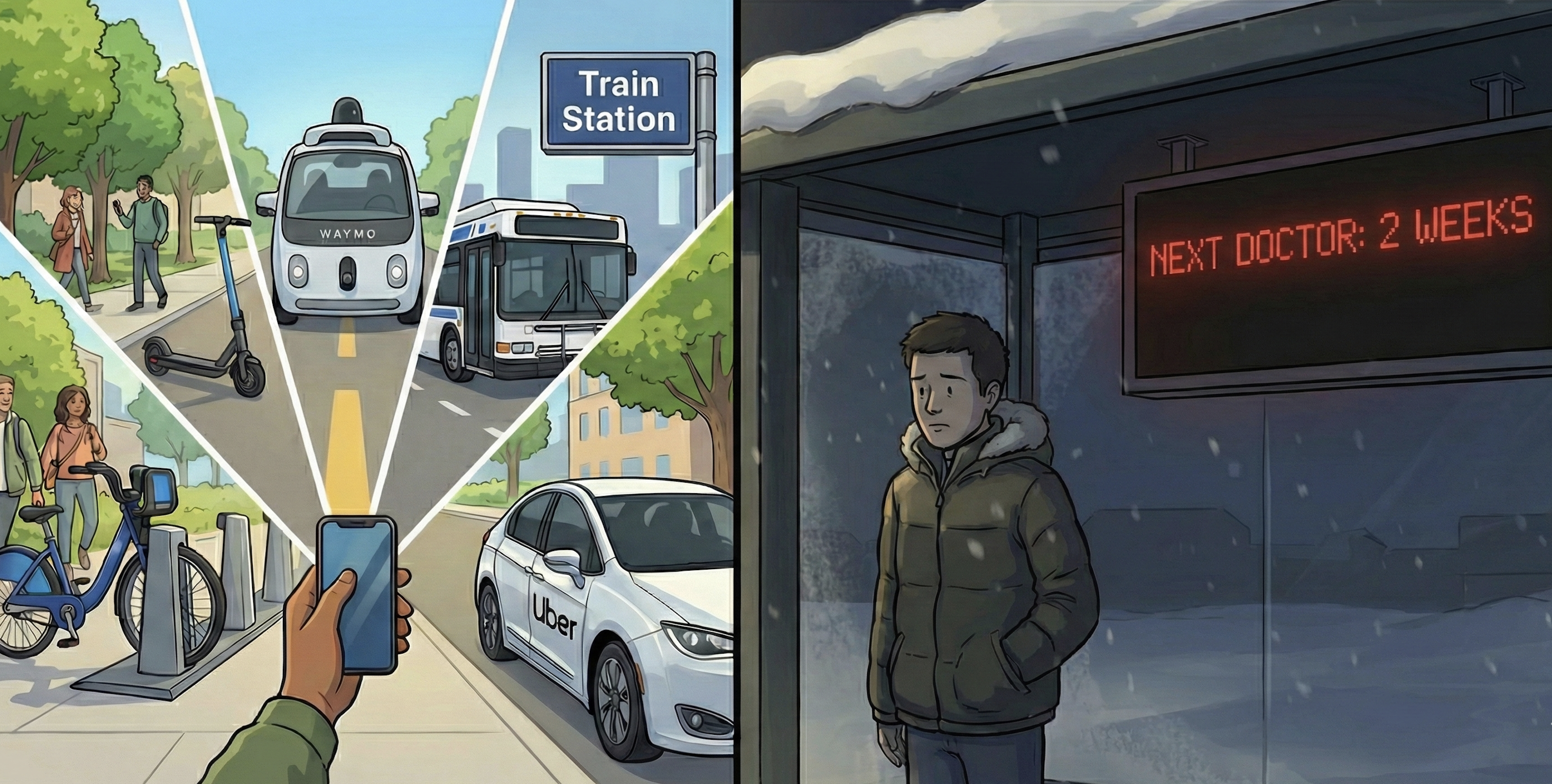
There's a popular analogy circulating in health tech circles: AI in healthcare should follow the Waymo model. The argument goes something like this: Waymo has proven that zero tolerance for safety incidents is the path forward. Self-driving cars waited until they were demonstrably safer than humans before scaling. Healthcare is safety-critical too, so shouldn't we demand the same perfection before deploying AI tools for patients?
I've heard this framing from investors, policy folks, and fellow physicians. And every time, I find myself thinking: this fundamentally misunderstands both healthcare and transportation.
To be fair to the Waymo analogy: there's real value in staged deployment, rigorous monitoring, and systematic incident response. Waymo's approach to building safety infrastructure, measuring outcomes obsessively, and scaling only when the data supports it represents genuine best practices for deploying high-stakes technology that isn't urgently needed. If that's what people mean when they invoke Waymo, I'm largely on board.
But the analogy breaks down when you use it to argue for "wait until perfect." And it breaks down even further when you examine what problem each technology is solving, what alternatives exist for people who need help now, and who actually bears the risk when something goes wrong.
I'm an urgent care physician. I see the consequences of our current first-mile-of-care every shift: patients who delayed seeking help because they couldn't get answers, who showed up to the ED for conditions that could have been managed at home with the right guidance, who made poor health decisions because they couldn't reach anyone who knew their situation.
The Waymo analogy isn't just imprecise. It's counterproductive, excessively conservative, and just not how we should think about AI in healthcare. Let me explain why.
The Problem to Be Solved Is Fundamentally Different
When Waymo set out to build autonomous vehicles, they were solving a problem of convenience. Getting from point A to point B is something humans can already do, reliably, safely, and through multiple well-established alternatives. You can walk. You can bike. You can take the bus, call a taxi, get a ride from a friend, or drive yourself. The car is the most popular option in America, but it is far from the only one.
Waymo's value proposition was never "we will give you access to transportation you couldn't otherwise have." It was "we will give you a more convenient, eventually cheaper, and potentially safer version of something you can already do."
Healthcare is categorically different. Consider what happens when someone wakes up at 11 PM on a Monday with a new symptom: chest tightness, abdominal pain, a rash that appeared suddenly. What are their options?
They could message their doctor through the patient portal. According to the American Medical Association, Cleveland Clinic's stated response time is 72 hours 1. Many health systems quote one to three business days. That's not 11 PM tonight; that's possibly Thursday.
They could call the nurse advice line. But there's good evidence that nurse triage lines, operating under liability-conscious protocols, systematically over-triage patients to emergency departments. A study published in Health Affairs Scholar found that supplementing nurse lines with direct access to emergency physicians reduced ED visits, a tacit acknowledgment that the standard approach sends too many people to higher-acuity settings 2.
They could go to the emergency room directly. About 30% of ED visits could be better addressed in primary care settings, according to AHRQ estimates 3. That's not necessarily the patient's fault; it's what happens when the only door that's reliably open is the emergency department.
Or they could do what most people actually do: turn to AI. According to OpenAI, more than 40 million Americans use ChatGPT daily for healthcare questions 4. Before generative AI, it was "Dr. Google," and that moniker tells you everything about what patients have always wanted: access to a doctor, at any time, for any question, no matter how big or small. Generative AI has shifted the paradigm from seeking information to seeking knowledge, guidance, and expertise.
This is the first mile of care in America. I call it that, though it understates things. For most people, most of the time, this is their relationship with the healthcare system: not the visits, but the space between them. It is characterized by lack of optionality and lack of safety, not an abundance of safe alternatives like we have for transportation.
The Stakes of Inaction Are Different
Waymo could afford to wait. When they were in development, every person who wanted to go somewhere had multiple other ways to get there. The cost of Waymo not being ready was that people drove themselves, took an Uber, or called a cab. Inconvenient, perhaps. But not a crisis.
Healthcare is in crisis. Premiums are rising. Subsidies are expiring, and millions will lose coverage or choose not to seek care they can't afford. For those who do try to access the system, they face massive shortages and months-long wait times.
The cost of all this is enormous, but we measure it poorly. Mortality statistics capture some of it. Studies on diagnostic delay capture a bit more: the cancer caught late, the stroke symptoms dismissed too long. But what we don't measure well is the morbidity—the suffering people endure while waiting for care they can't get. The psoriasis that spirals out of control. The migraines that become disabling. The symptoms of chronic illness that go unaddressed for months or years because there's simply no one available to help. This suffering rarely makes it into the statistics on healthcare access. It doesn't land the way mortality does. But it's real, and it's everywhere.
If we reach a future where everyone has instant access to clinical guidance, and we're rapidly approaching this future, people will look back and find it barbaric that anyone ever waited a month to talk to a doctor. They'll find it absurd that people waited days for a response to a simple question. They'll wonder how we accepted hours of uncertainty as the price of getting care.
The wait-for-perfection approach implicitly assumes that the current state is acceptable, that we can afford to delay improvements until AI tools match or exceed physician quality across all dimensions. But the current state is not acceptable. It is a depth of scarcity that the status quo has made it impossible for us to see clearly.
Patients Are Not Waiting for Permission
Waymo needed permission to operate. Before a single paying customer could hail a robotaxi, Waymo had to navigate years of regulatory approval, demonstrate safety to government agencies, and receive explicit authorization to operate on public roads. The permission structure exists because autonomous vehicles share space with everyone else: pedestrians, cyclists, other drivers. Society gets a say.
There is no such structure for consumer health AI. Anyone with an internet connection can open a chatbot right now and start asking medical questions. No regulator is going to approve or deny that interaction. No agency is measuring whether it's safe. The gate that Waymo had to pass through simply doesn't exist here.
And patients are walking through that open door in massive numbers. Three in five U.S. adults say they've used AI tools for health in the past three months. Seven in ten of these conversations happen outside clinic hours, exactly when traditional access fails.
But here's what the statistics don't capture: for many of these people, this isn't "health guidance." It's becoming their healthcare. I see it in clinic. Patients come in having already had a conversation with an AI tool, often with the right diagnosis in hand. They're using AI not as a supplement to the care they receive, but as a replacement for the care they can't access. We shouldn't be surprised. The need is enormous and the supply is inadequate.
The question is not whether patients will use AI as healthcare. They're doing it now. The harder question is who will build what they actually need. The clinicians and patients best positioned to design these tools face liability barriers that healthcare systems won't touch. What we're left with is either continued off-label use of general-purpose AI—the modern 'Dr. Google'—or, if we're lucky, purpose-built tools from those willing to take the risk.
Regulators are beginning to acknowledge this reality. FDA Commissioner Marty Makary recently stated that the agency won't attempt to police general-purpose AI tools for health: "If something is simply providing information like ChatGPT or Google, we're not going to outrun that lion. We're not going to go in there and say, 'There's one result that is inaccurate, therefore we've got to shut this down'" 5. When even the FDA concedes it cannot gatekeep general-purpose AI tools for health, we need new frameworks, not permission structures that don't exist and can't be enforced.
The Externalities Are Different
This brings me to the most fundamental disanalogy: who bears the risk. If you take a self-driving car and it runs over my cat, I'm going to be upset. This actually happened in San Francisco when a Waymo killed a beloved neighborhood cat 6. You decided to use a new technology, and your choice put someone else's life at risk. That's the core moral problem with autonomous vehicles on public roads: one person's decision to adopt a convenience creates danger for people who never consented to that risk. A pedestrian didn't sign up to share the street with an algorithm. Another driver didn't agree to trust their safety to someone else's software.
This is why society demands a permission structure for self-driving cars. The externalities are real, and your choice affects me.
Health AI is structurally different, though not without externalities of its own. When someone uses an AI tool to understand their symptoms, decide whether to seek care, or prepare questions for a doctor's visit, the primary risk falls on them. If the tool gives poor advice and they follow it, they bear the consequences.
But I should acknowledge the second-order effects. Poor AI guidance could lead to unnecessary ED visits that strain system capacity. A missed suggestion to isolate could spread a contagious illness. Inappropriate antibiotic requests, if granted, contribute to resistance. A parent making decisions for a child, or an adult child caring for an aging parent, creates risk for someone who didn't choose the tool.
These externalities are real. But the comparison point isn't zero harm. It's the harm already happening when people turn to TikTok, well-meaning relatives, or nothing at all. When a parent Googles their child's symptoms at midnight and lands on a forum full of misinformation, that's the baseline. The question is whether AI guidance produces better population-level outcomes than the realistic alternatives people are already using, not whether it's perfect.
This is not a minor distinction; it goes to the heart of how we think about informed consent and patient autonomy 7.
We already allow people to make decisions within healthcare that aren't good for their health. Patients skip medications that could save their lives. They decline recommended treatments. They pursue cosmetic surgeries with real risks and no medical necessity. The principle is consistent: competent adults have the right to make informed decisions about their own bodies, even decisions that physicians might disagree with.
Outside of healthcare, we extend the same autonomy. You can jump out of airplanes. You can ride motorcycles. You can smoke cigarettes. The world is full of tools and activities that can harm or kill us if used incorrectly, and we let people choose. A butter knife is safer than a steak knife. A hand saw is safer than a chainsaw. We don't ban the more dangerous tools; we expect people to understand the risks and use them appropriately.
Maybe this is the right frame for health AI: not as a pseudo-physician that needs to be licensed, but as a tool that exists on a spectrum of capability and risk. Tools require frameworks for reasonable use, not permission structures that prevent use entirely. There's another dimension here: autonomy isn't just about accepting risk, it's about retaining control. When you get into a self-driving car, you surrender control. You can't grab the wheel. If the car is moving, you can't even stop it. Your fate is in the hands of the algorithm.
Health AI is nothing like this. You can disagree with what it tells you. You can get a second opinion, or a third. You can ignore its suggestions entirely. You can walk into a doctor's office the next morning and ask a human physician to weigh in. The tool doesn't take over; it informs. The decision remains yours.
An AI health tool that is transparent about its limitations, that clearly states it is not a replacement for professional medical care, that acknowledges uncertainty, that recommends physician consultation for serious concerns, is offering a resource that a fully informed person can choose to use or ignore. There is no third-party pedestrian being put at risk by that choice. And there is no surrender of autonomy to a machine that cannot be overruled.
The Waymo analogy fails on every dimension that matters: the problem being solved, the stakes of inaction, the permission structures involved, and who bears the risk. It's not just an imperfect comparison. It's a comparison that actively misleads us about what consumer health AI is and what it requires.
But pointing out that the analogy is wrong doesn't tell us what framework we should use. In Part 2, I'll examine healthcare's uncomfortable relationship with measuring its own safety, and why demanding rigorous benchmarks from AI reveals a double standard the industry has never applied to itself.
References
[1] Berg S. "What Doctors Wish Patients Knew About Using a Patient Portal." American Medical Association. June 17, 2022. https://www.ama-assn.org/practice-management/digital-health/what-doctors-wish-patients-knew-about-using-patient-portal
[2] Saadat S, et al. "Medical advice lines offering on-demand access to providers reduced emergency department visits." Health Affairs Scholar. December 2023. https://academic.oup.com/healthaffairsscholar/article/1/6/qxad079/7459835
[3] "Appropriate ED Utilization Leading to Better Care Coordination." American Journal of Managed Care. December 2025. https://www.ajmc.com/view/appropriate-ed-utilization-leading-to-better-care-coordination
[4] "40M users turn to ChatGPT daily for health questions: OpenAI." Healthcare Dive. January 2026. https://www.healthcaredive.com/news/40-million-use-chatgpt-health-questions-openai/808861/
[5] Makary M. Comments on FDA approach to AI regulation. Fox News. January 6, 2026.
[6] Neff C. "Death of beloved neighborhood cat sparks outrage against robotaxis in San Francisco." The Guardian. November 5, 2025. https://www.theguardian.com/us-news/2025/nov/05/san-francisco-waymo-kitkat-cat-death
[7] "Informed Consent." StatPearls, National Library of Medicine. November 24, 2024. https://www.ncbi.nlm.nih.gov/books/NBK430827/