This is a really, really long essay about my right pinky finger, probably the longest one you’ll read this year. It’s also my account, as a physician, of my latest encounter with the healthcare system, in all its glorious inattention to time.
You’ve come this far, you might as well keep reading!
Thanks for reading Sovereign Care! Subscribe for free to receive new posts and support my work.
3 months ago ago we ordered sushi. Somewhere in the middle of dinner, holding my chopsticks, I felt something I’d never felt before: the tip of my pinky touching my palm.
It’s a strange thing to describe. There was no pain. Nothing dramatic happened. Just a small, wrong sensation, the kind your body files away as unfamiliar before your mind catches up. I looked at my hand as if I were seeing it for the first time in years. My pinky was sitting in slight flexion. It curled a little ahead of the other fingers, more pronounced when I flexed my hand, because the muscles that extend it were no longer holding their own.
I’m an urgent care physician. I knew exactly what I was looking at. But to explain what that moment meant, I have to go back about five years.
I blamed it on the blues
During the pandemic, like so many people, I got back into my hobbies. For me that meant the piano. I’d played classical piano for many years, and in 2020 I decided to do something I’d always wanted to do: study jazz, seriously, with a new teacher. I threw myself at it. Hour after hour, day after day, starting with the core skill playing the blues.
So when my arm and hand began to ache, I reached for the obvious story. Tendinitis. Overuse. I blamed it on the blues.
My jazz teacher recommended a hand surgeon he knew, a man he described as both a fantastic surgeon and a talented visual artist and musician.
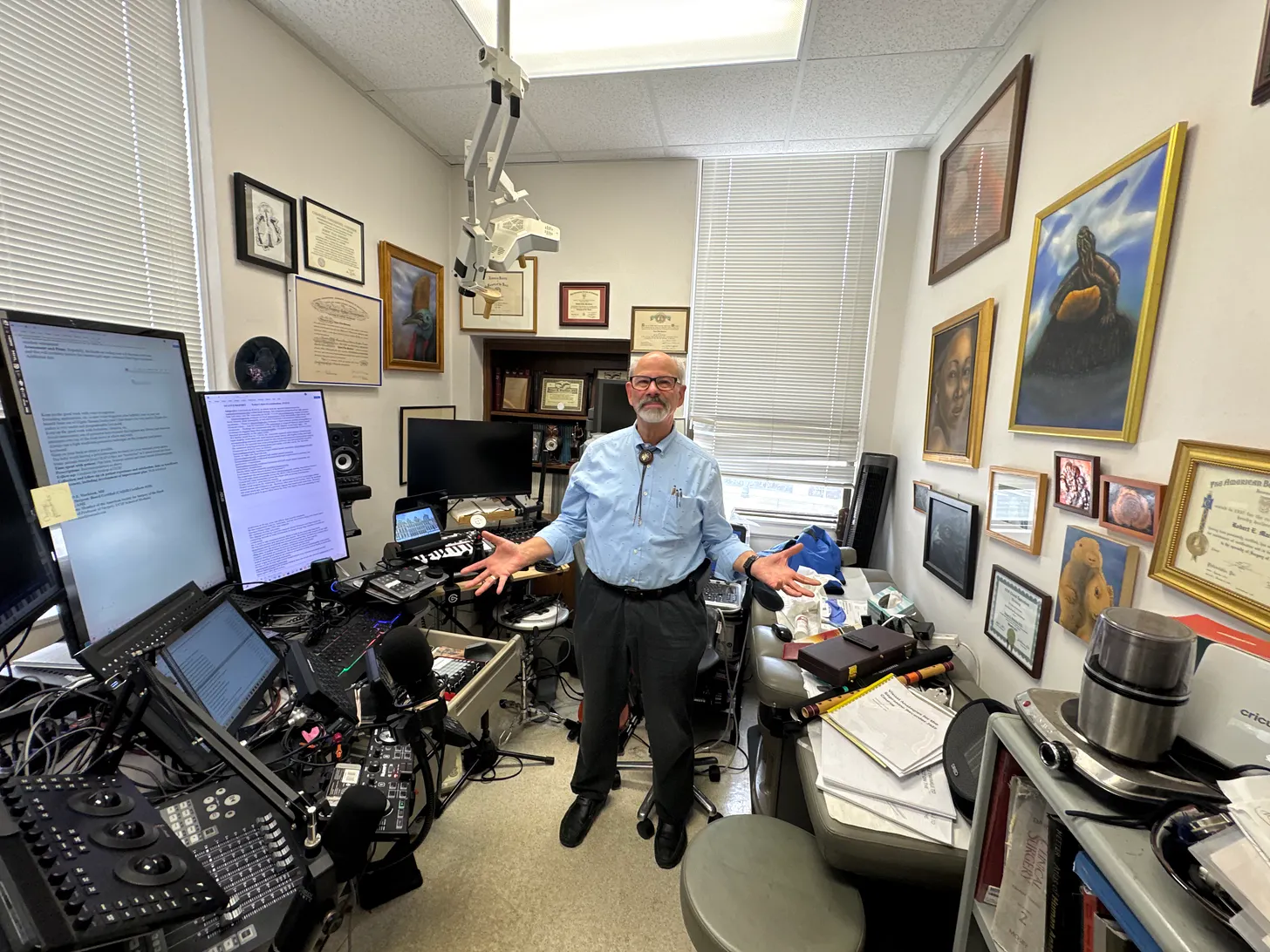
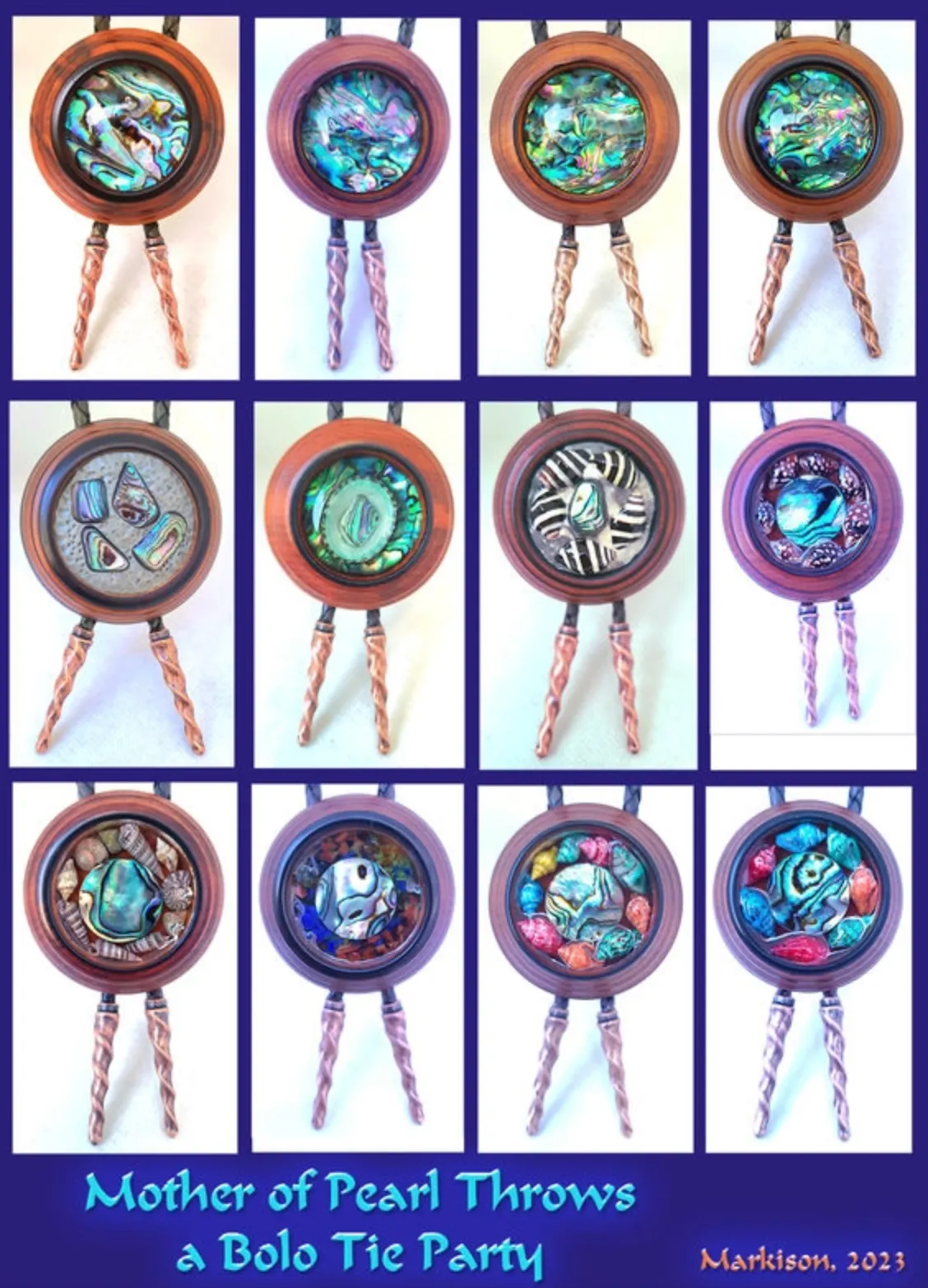
He was right. You could tell from the waiting room that this was no ordinary doctor. The walls were filled with art, which his receptionist proudly told me he had made himself. Paintings. Drawings. Framed magazine and newspaper articles about his dual life as artist and surgeon. He makes glass bolo ties and tiny, beautiful glassblown sculptures of hummingbirds.
When I got into the exam room, I felt the kind of energy you only get from old-school physicians, the ones who look you in the eye and examine you with deep confidence. He interviewed me about my practice schedule and then gave me advice on everything. Play tiny instruments, he said, at which point he pulled a micro (piccolo) recorder out of his desk drawer and started improvising over rhythm changes at unbelievable speed. He put it down and kept going: how to rest my hands, how to warm up properly, how to change my diet. He warned me to be careful about typing and mousing. This was a man who, years before voice dictation was fashionable, had rigged his own dictation system with foot pedals so his hands would never have to do work his feet could do.
He was one of the most delightful physicians I have ever met. And, interestingly, he missed the diagnosis, at least at first. I don’t say that as an indictment. I say it because in our current paradigm of care, for many conditions the right diagnosis emerges with time, and after a sequence of wrong working diagnoses. If a brilliant, musician-fluent hand surgeon who builds his whole practice around hands like mine can miss it, then the problem isn’t bad doctors.
And so I spent about two years inside that wrong story.
When my pain didn’t improve, I went for a second opinion at UCSF, and it was there that someone finally gave me the diagnosis that, in retrospect, was obvious: cubital tunnel syndrome.
The lesser known tunnel
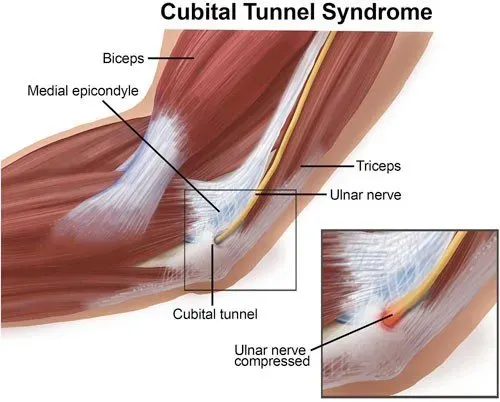
Most people know carpal tunnel syndrome. Cubital tunnel is its lesser-known cousin with a different geography. The ulnar nerve passes through a narrow tunnel on the inside of the elbow, directly behind the spot we all call the funny bone. If you’ve ever banged your funny bone and felt that electric jolt shoot down into your ring and small fingers, you’ve met the ulnar nerve. It carries sensation to those fingers, and, more importantly for this story, it powers most of the small muscles of the hand itself. The muscles that spread your fingers, that pinch, that give your grip its fine control. Muscles essential for piano playing.
When the nerve gets compressed at the elbow, those muscles slowly starve. The feared endpoint is the claw hand, where the small muscles waste away and the fourth and fifth fingers curl into a posture they can’t escape. And here’s the part that makes cubital tunnel syndrome insidious, a word the condition has thoroughly earned: the loss can happen with little pain and little numbness, so gradually that you don’t notice until the damage is done. Once those motor axons die, they don’t come back. With nerves, just as with the heart, time is tissue.
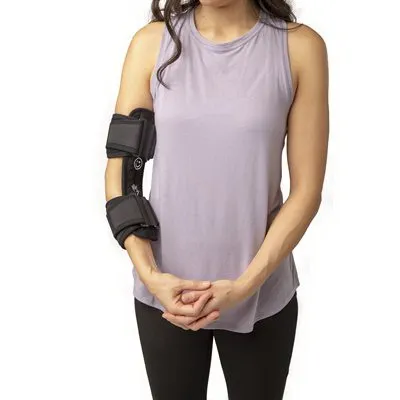
My first electromyogram (EMG) showed very mild slowing of the nerve conduction, on both sides, right worse than left. The recommended treatment was the standard rigid night brace, which keeps you from bending your elbow while you sleep. I tried. I really tried to be a good patient. But I could not sleep in that brace, not in any variation, and certainly not in two of them at once.
It was at this point, knowing what I knew about how quietly this condition does its work, that I did something I don’t think many patients do. I decided I was going to monitor it quantitatively. I bought a Jamar pinch gauge and a Jamar smart grip dynamometer, the same instruments hand therapists use. The two of them set me back many hundreds of dollars. I figured that nerve damage can be so subtle that I needed numbers, not impressions.
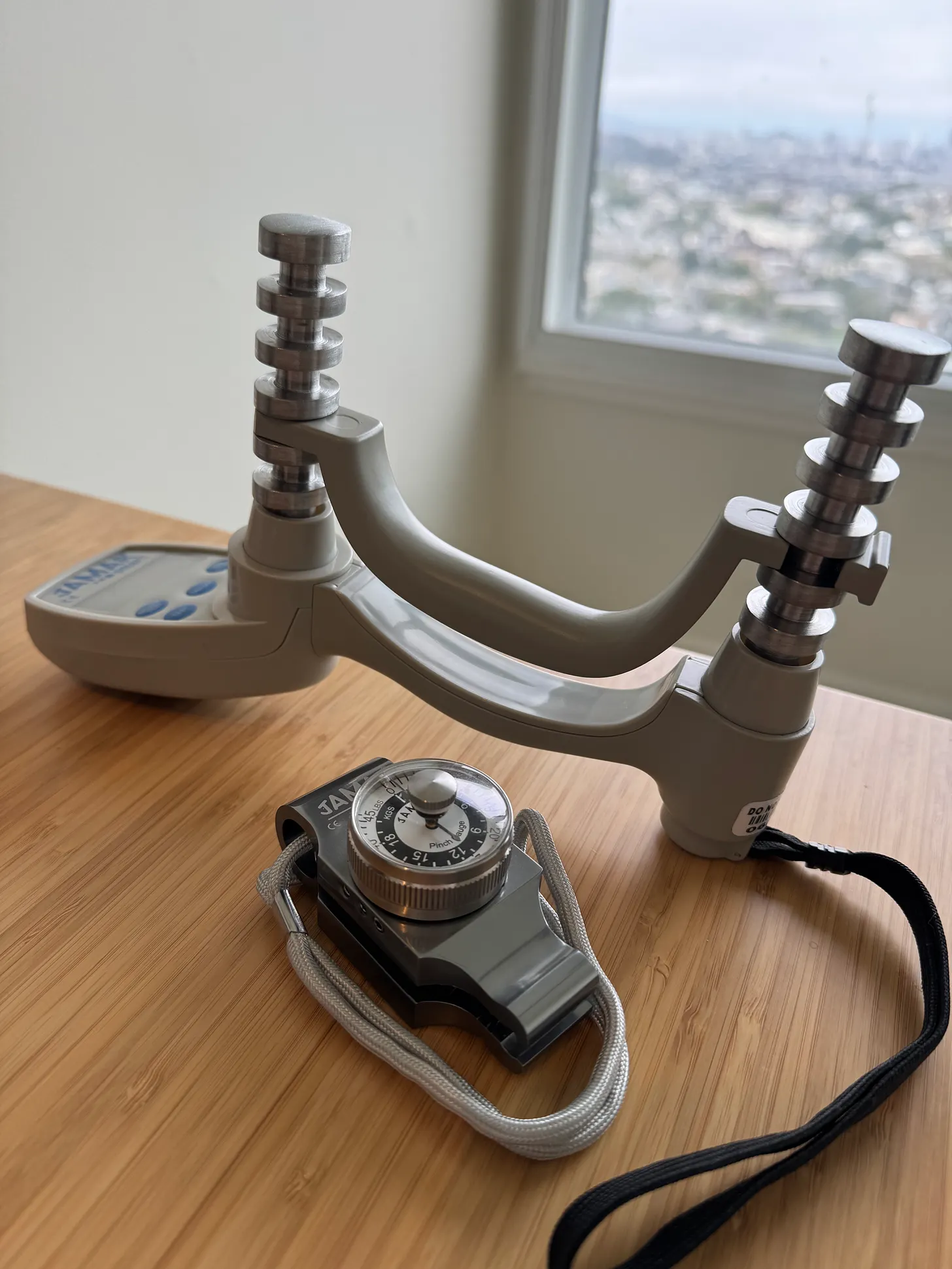
For months I measured. My strength held steady. I started to think I was in the clear, though I kept measuring anyway.
Then a funny thing happened. The numbers stayed the same, but my hand got worse.
Diagnosed by a machine originally invented by Bartolomeo Cristofori in 1700
It’s hard for me to convey to people what music is for me. It’s something akin to psychic, intellectual, and emotional nourishment. I experience music the way I imagine many people experience food, really delicious food, when you’re starving. When I’m not thinking about medicine or AI, I’m thinking about music, humming tunes. I dream about music almost every night.
At the keyboard, I started making mistakes I had never made before. My hand would behave as if it had one too many drinks. That’s the only way I could describe it. It couldn’t find its place on the keys the way it used to, effortlessly, the way it had for decades. There was no significant numbness. Pain, if I had any, was minimal. Just this drunken clumsiness in a hand that had played Chopin etudes, Beethoven Sonatas and, more recently, jazz.
The grip meters, the tools used by occupational therapists, said I was fine. The piano, originally invented in 1700, said I wasn’t. A repeat EMG settled the argument: axonal injury. Dying nerve.
There’s a longer story to tell someday about the power of clinical observation, about the neurologic exam, about what strength testing can and cannot see. But the short version is that the piano was more sensitive than a modern digital dynamometer.
Open a textbook on cubital tunnel syndrome and you’ll find functional descriptions that have barely changed since the early 1900s. Trouble with buttons. Difficulty with sewing. Nothing about keyboards. Nothing about pianos. Medicine’s vocabulary for what this nerve does was written for a world of buttons and thread, and it has no way to capture the signal I was getting, which arrived years ahead of the buttons. There’s no billing code for “my hand can’t find the keys anymore.” But it was the truest data I had.
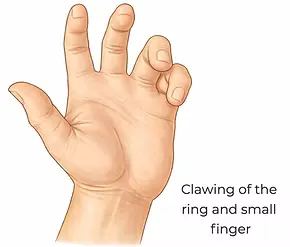
When I understood what was happening, I had a sinking feeling I can still summon. The idea that my piano playing could be taken from me by this slow, silent loss was devastating in a way I struggled to explain to anyone. The week and a half before I met my surgeon felt like an eternity. I have never in my life been so excited to have a surgery.
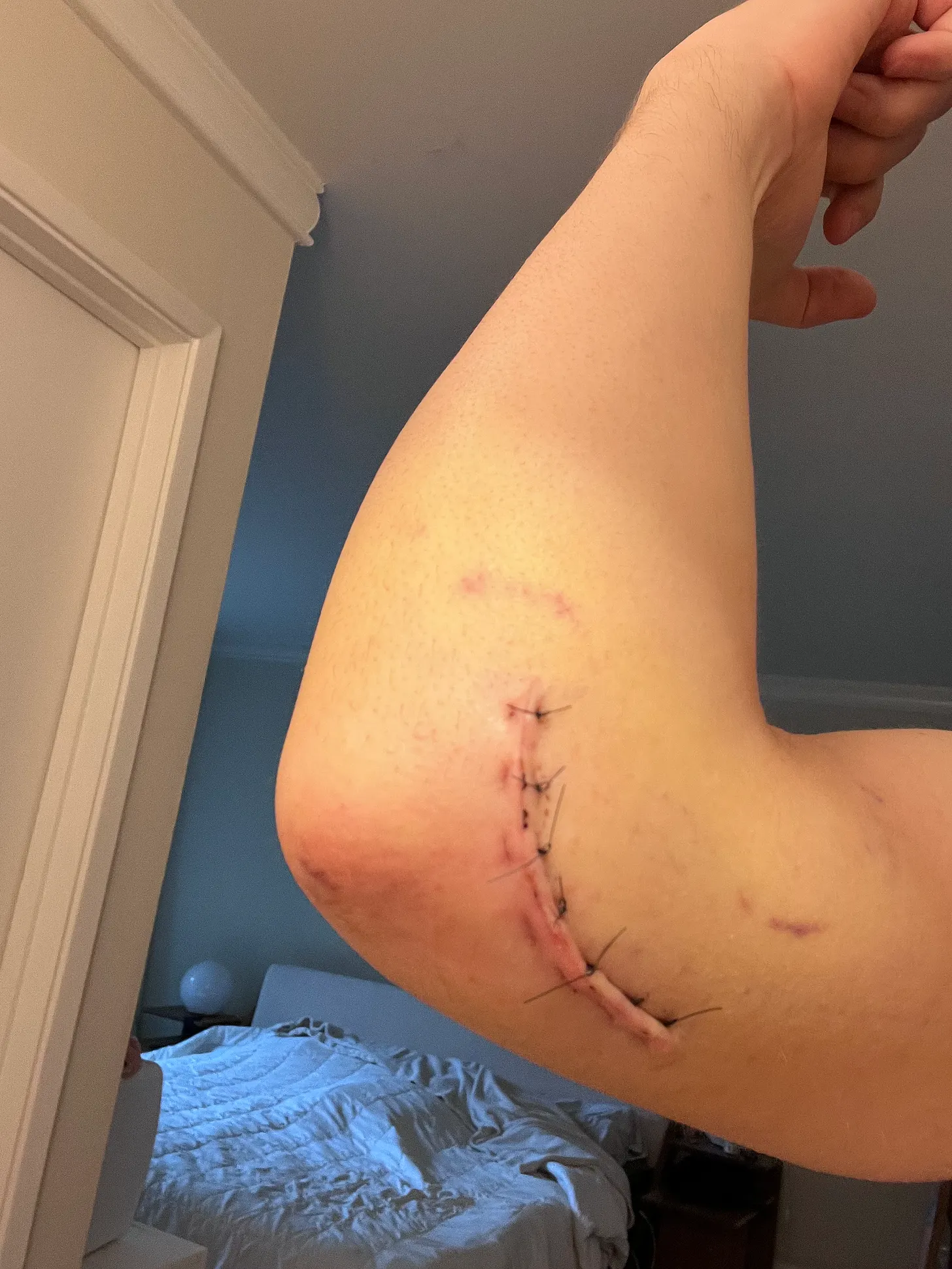
The decompression, in 2023, worked. By then I already had mild atrophy in my hand. Unluckily for me, my recovery took far longer than promised. My surgeon told me six months; my body had other plans, and I probably set myself back trying to advance activity too soon. I’m a slow healer.
And here’s a small truth from inside medicine: we have no good measure of an individual’s healing speed. None. Surgeons quote timelines with a precision not well supported by evidence Yes., because patients want a number - and the alternative is admitting we don’t know. But I recovered, mostly. I never regained all the muscle I’d lost. I went back to my life, retrained my piano technique with an excellent Taubman teacher, and kept learning more jazz standards.
The second time
For the past two years I’ve been building My Doctor Friend. We’re a team of two. I spend enormous amounts of time at the computer: coding, writing, so much writing, so much mousing. I dictate now instead of typing where I can, but dictation doesn’t save you from the mouse, and like any right-handed person I do nearly all of my mousing with my right hand.
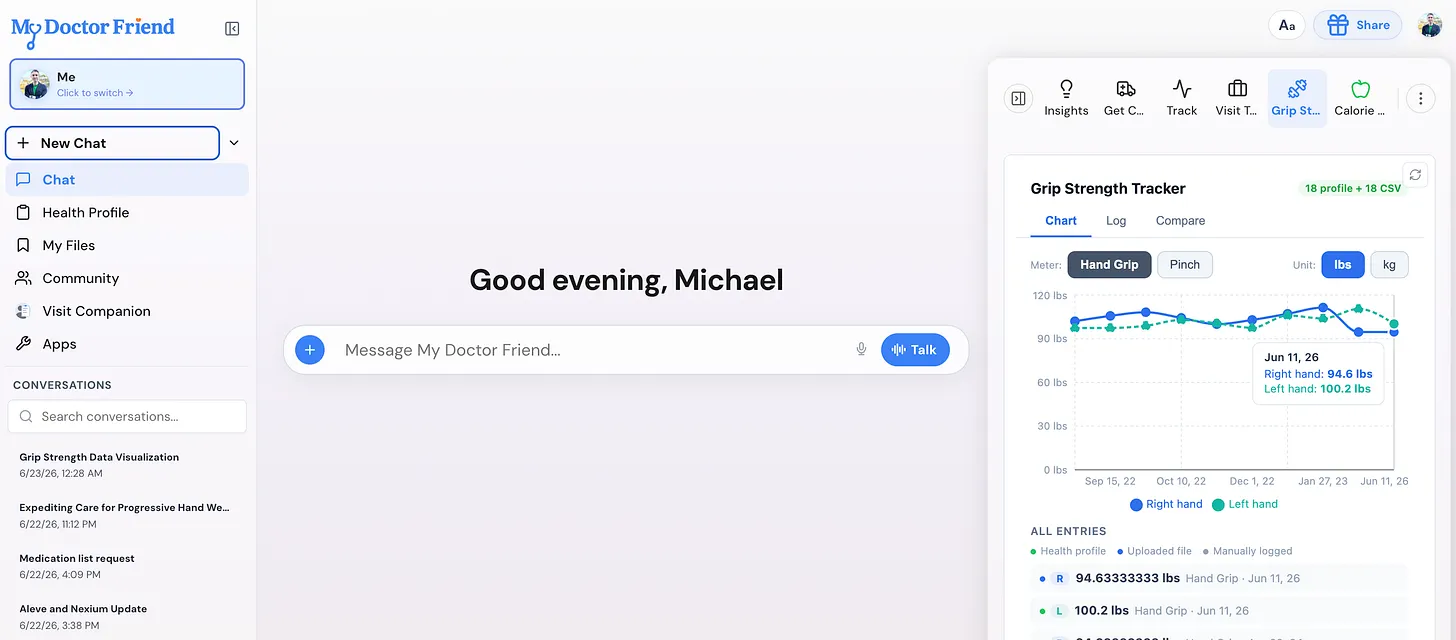
Over the last few months, the pain in my hands started climbing. I pulled back from the gym. And my life got so busy that I didn’t think to measure my strength.
About a month and a half ago I was carrying groceries, and my right hand just didn’t seem right. The bags in my right hand felt heavier than they should. My grip felt like it was loosening around the handles. I transferred a bag to my left hand and it was no problem at all. Some part of my mind flagged it. Some other part filed it under “residual from the surgery, you never got all that muscle back” and moved on.
Then the chopsticks. The pinky tip against the palm. The fingers coming together with the pinky arriving a little ahead of where it should be. And that’s when it dawned on me: the cubital tunnel syndrome had come back, and it had come back so quietly that the first reliable alarm was a piece of nigiri.
The painful irony was not lost on me: I’m building a company whose entire premise is that patients need better tools to self-manage and monitor their own health, and I missed my own recurrence because I was too busy building it. Vigilance as a personal virtue is not a strategy, not even for the people who preach it. It’s an argument for better tools, technology, and modern care infrastructure, not for trying harder.
I dug the grip meters out of the closet for the first time in almost two years. My grip strength, a number that had never moved significantly, not even before my first surgery, had dropped fifteen percent.
Door to decompression time
Everything up to this point is a medical story. What follows is a systems story about waiting, a frustrating one all too familiar for most of us.
I tried to message my surgeon at UCSF, the one who had operated on me three years earlier. Epic no longer considered her part of my care team, so I couldn’t. The portal had administratively forgotten our relationship. So I had to schedule as a new patient, in the same office, with the same surgeon. First available appointment: one month out.
I called the office and pleaded. Was there anyone I could see sooner? By pure luck, there was a last-minute cancellation, and I got in to see the physician assistant on her team the next day. I felt fortunate, relieved. I want to flag how strange this is. The system’s failure modes are so normalized that catching a cancellation feels like winning something, rather than what it is, which is a lottery ticket standing in for triage.
At the clinic, the front desk took my insurance card and told me I’d be called back shortly for x-rays. X-rays? Why would I need x-rays, which would be near useless for recurrent cubital tunnel syndrome? I must have looked puzzled. Well, she explained, all new patients get x-rays. I told her I wasn’t a new patient. Is this a new health issue? No, it’s the same issue. She was visibly unhappy. I was breaking protocol. She called someone, came back, and applied more pressure: they really want you to get the x-ray.
So I did the thing I genuinely dislike doing. I told her I’m an urgent care physician, that I order hand x-rays all the time, that I most definitely do not have a fracture, and that there is no good reason for me to get an x-ray. There was no way this doctor, living on a meager startup income, was going to pay hundreds of dollars for studies no clinician had evaluated me for, ordered reflexively because the schedule said “hand pain.” This after I’d spent fifteen minutes the night before filling out online intake forms that nobody appeared to have read.
I want to be clear that the people in this story are not villains. The PA, to his credit, was thoughtful, recognized the problem quickly, and ordered an EMG urgently along with a specialized nerve ultrasound. He also warned me that exactly one person at UCSF can perform the ultrasound I need. One.
That afternoon I got the call from EMG scheduling. The soonest appointment was two months out.
Two months! For a study marked urgent. For a condition where one of the critical nerves powering my dominant hand could be dying on a schedule nobody has ever measured.
The scheduler offered me two locations, San Francisco or Redwood City, and asked which I’d like. I asked to be put on the waitlist. She told me the waitlist only applies to the location where your appointment is booked. So I asked her a question she had to go look up: how many EMG physicians work at each site? Three in San Francisco, one in Redwood City. The Redwood City slot was a couple weeks sooner, but three physicians generate more cancellations than one. So I took the later San Francisco date and bet on cancellation density.
Cancellation density. To get timely care for progressive nerve damage at one of the premier medical centers in the world, where I went to medical school, and where I have been working for nearly seven years, I was running queueing theory against my own hospital’s scheduling system. That was the tool available to me. Not a clinical pathway. A hunch about probability distributions.
Nobody cares how long you wait, unless you tell them
In 2015, the National Academy of Medicine, then the Institute of Medicine, published Improving Diagnosis in Health Care. It was a watershed report. It established diagnostic error as one of the great underexamined harms in medicine and estimated that most of us will experience at least one diagnostic error in our lifetime.
A decade later, here’s what we still don’t have: any standard for how long a patient should wait, with active symptoms, for a diagnosis. No benchmark. No measurement. No accountability. We have door-to-balloon time for heart attacks and door-to-needle time for strokes, because someone decided those minutes mattered enough to count. For nearly everything else, the interval between “something is wrong” and “we know what it is” belongs to no one.
At UCSF, as far as I can tell, the electronic medical record offers roughly four levels of urgency for a study like mine. STAT, meaning within the next 72 hours. Same day, meaning within a week. Urgent, meaning weeks to months. Routine, meaning it may get done within a year. That’s the entire vocabulary. The PA who ordered my EMG urgently gets no notification of when it was actually scheduled. He has zero visibility and zero control. To my knowledge, none of these intervals are audited. Nobody is measuring the gap between the order and the answer, which means nobody is responsible for it, which means it can be two days or two months or four months and the system registers no difference.
And here’s the part that might infuriate me most. Nobody at UCSF said, or could say, “Stanford might get you in sooner. Try Sutter.” It didn’t occur to anyone, because it isn’t part of how the system works. The institution’s power and creativity end at its own walls, even when what’s at stake on the other side of the wall is my hand.
I had the unfair advantage of being a motivated and well-informed patient, and a physician. And so I called every facility in the city that takes my insurance (and maybe some that don’t) and found the soonest EMG I could, at Stanford. Because I knew that nerve damage is usually permanent. I knew that the word “urgent” in the chart is a label, not a promise. I knew to ask how many physicians staff each waitlist.
But most patients don’t know any of that. Most patients hear “the first available appointment is in two months” and conclude, reasonably, that two months must be safe. Why else would the hospital offer it? The schedule itself masquerades as a clinical judgment of appropriateness and timeliness, and for most conditions it’s nothing of the kind. It’s just the queue.
The assumption underneath
There’s a simple framing underneath all of this. Our healthcare system was built on a deep assumption of scarcity and patient ignorance. Scarcity explains the queue. Ignorance explains why we tolerate it. A system constructed this way only works if most of the people inside it don’t understand the consequences of its dysfunction, of delay.
This is just another reason why we need patient-operated healthcare. Not because patients should have to learn queueing theory to protect their nerves, but because right now the only reliable advocate for timely care, the only people who experience the wait as harm rather than as a scheduling artifact, are patients and their loved ones. The institution wouldn’t feel my two months. My surgeon wouldn’t be notified of them. The EMR would record the study as completed, on time by definition, because no definition of “on time” exists.
Coda
My pinky continued to curl, and I stayed away from the piano out of fear. My heart ached for the music I couldn’t play, and for the music that might forever be out of reach. Somewhere in a scheduling database, my urgent study was sitting in a slot in August, and no part of the system considered that a problem. So I kept calling.
Over the next several weeks, I spent more than fifteen hours on the phone with schedulers, getting urgent appointments at my own institution and at Stanford, moving studies around, looking for cancellations, and trying to persuade people that this actually was urgent. I paid several thousand dollars out of pocket - even with what’s considered a good deductible these days. Eventually, I managed to compress what might have taken months into a few weeks. And then, after all that effort, the answer was not at all straightforward.
My symptoms were atypical. Several times I found myself doing something I had warned patients against for years: diminishing my own symptoms. It’s something of an occupational hazard. Maybe I was overreacting, I thought. Maybe this was just residual weakness from my old injury. Maybe I didn’t really need to push this hard. This is, I have to say, where My Doctor Friend helped me in an unexpected way - it reminded me to look at myself the way a caring doctor would care for his patient; which is to say, not wait for certainty when the stakes for the patient are high. Finally, I started to truly believe what my hand was telling me.
Equivocal Studies
The repeat EMG was equivocal. Some measurements looked better than before. Some looked worse. The MRI wasn’t normal either. Just proximal to Guyon’s canal (the narrow passageway at the wrist through which the ulnar nerve enters the hand), there was a short segment of faint abnormal signal within the nerve. The nerve was telling us that something had happened to it. What the MRI could not tell us was whether that represented active injury, old injury, or something that required another operation. There was no definite enhancement and, reassuringly, no new muscle atrophy. In other words, I had accumulated abnormalities without accumulating an answer.
One of the most useful pieces of information came not from the imaging but from the physician who performed my exam and EMG at UCSF. She was a PM&R doctor, and after doing the study she performed an extraordinarily careful neurologic exam. My strength looked essentially full at first. But she kept testing my 5th finger against resistance, and with repeated testing, it began to tremble and give way. It was fatigable. I hadn’t known to look for that. Apparently neither had anyone else.
2nd Opinion from a Doctor Who Hates Patient Scribes
Two weeks later, I went to Stanford for a second opinion from a neurologist while I was still waiting to hear back from my hand surgeon. It was one of the more unpleasant encounters I have had with another physician in a long time. When I go to doctor’s appointments now, I often use tools we have built at My Doctor Friend. Partly I do this because I want to experience them the way a patient does. One is a visit companion: essentially a patient-side scribe that transcribes the visit, keeps track of what is being discussed, and helps surface questions you might otherwise forget to ask.
I usually explain what it is and ask permission. I told the neurologist that I was a physician developing a tool for patients, that it worked somewhat like the AI scribes doctors increasingly use themselves, and that it didn’t save an audio recording. Her reaction was immediate. “Absolutely not. I will not have any recording device in my exam room.” I could see a flash of anger on her face. The visit never quite recovered from there.
I told her the story. She reviewed the UCSF EMG. And I had the uncomfortable sense that she could not quite understand why I was sitting in her office. I had already been evaluated at UCSF. My hand did not show dramatic wasting. Most of my strength testing was normal. I suspect I looked, to her, like a worried-well patient shopping around for another opinion. Maybe I was reading too much into it. But as a patient, the feeling was unmistakable: I was getting the worried well treatment.
Her examination was clumsy compared to the one I had received at UCSF. There was no quantitive testing, no prolonged testing to test the fatigability in my pinky. After reviewing my imaging, she explained, reasonably, that an ulnar nerve can remain enlarged after an old injury and that enlargement alone does not prove ongoing damage. If the weakness progressed, she said, I should come back. It was medically defensible advice. It was also useless. The entire problem was that I was trying to determine whether something subtle was progressing before it became obvious.
My Doctor Friend to the rescue
The best explanation I eventually got did not come neatly packaged in an EMG report or an MRI impression. It came from My Doctor Friend after I gave it the whole story and asked it to reason through the anatomy with me. After my first surgery, I had painstakingly redesigned my desk so that I would never again rest my elbow (and therefore my cubital tunnel) against a hard surface. I thought I had solved the ergonomic problem. What I had failed to notice was that I had moved the pressure somewhere else.
I was spending enormous amounts of time at the computer with the heel of my right hand planted against my mouse and desk. And just proximal to Guyon’s canal (almost exactly where my MRI showed that faint abnormal signal), the ulnar nerve passes into the wrist before dividing into branches that supply the small muscles of the hand. I had spent years protecting the nerve at my elbow while possibly irritating the same nerve farther downstream. My friend and fellow physician coder, Michael Hobbs, founder of wren.kids (a fantastic AI health companion for parents) had a catchy name for the syndrome: Claude Claw.
I can’t prove that this was the cause. No doctor could prove it either. The MRI finding itself was nonspecific. But suddenly the anatomy, the timing, my work habits, and the location of the imaging abnormality at least belonged to the same story. So I stopped using my right hand for the mouse almost entirely. I changed how I worked. I dictated even more. I found ridiculous ways to avoid touching the computer, including vibe-coding a voice-control system called “Gandalf” so I could operate my Mac without my hand. That’s another story.

And slowly, my hand began to improve. It still isn’t normal. I still have to be careful with it. But my pinky is no longer marching inexorably toward my palm, and I no longer feel as though I need to choose between emergency surgery and watching my hand disappear in slow motion. I am playing piano again. So this story has, at least for now, a happy ending.
But the ending did not make me feel better about the system that got me there. If you ever find yourself holding chopsticks and feel something you have never felt before, I want you to know that you are allowed to consider it a problem. Even if the symptom seems tiny, and it’s your pinky. Even if the first test is reassuring. Even if the specialist looks at you as though you are wasting her time.
You are allowed to call around for another opinion. You are allowed to refuse a diagnostic study that makes no sense. You are allowed to ask how a waitlist actually works. You are allowed to ask whether another hospital can see you sooner. You are allowed to keep asking questions when the tests don’t quite explain what your body is doing. The system is not going to give you permission to do any of this. It is not going to tell you to do any of this.
That’s the point. It was never designed to. If we want a healthcare system that actually responds to patients, we’re going to have to build one.
Thanks for reading Sovereign Care! Subscribe for free to receive new posts and support my work.
Originally published on Sovereign Care on Substack.