It feels like in the last month, the temperature has been turned up on the anger and frustration with AI. This is more than anger at data centers. It’s quite a bit more complicated, and the criticisms are increasingly as passionate as they are multifaceted.
Social media has a reputation for amplifying negative sentiment and negative emotions. We’re reading about it daily, whether on social media or traditional news sites. People are deeply worried about AI, for different reasons. They’re worried about their jobs. They’re worried about education. They’re worried about what this means for society and our values. And as AI becomes capable of solving math problems that had gone unsolved for decades and of carrying out cyberattacks on its own, there is widespread concern about the threat this technology poses to our society and even to humanity. Smart people believe that extinction risk from AI should be a global priority, alongside pandemics and nuclear war. 1
I share a lot of the concerns about the existential threats that AI may pose to our society and to humanity. But there is a piece that I myself wanted to better understand as a heavy user of AI. The reason for this is that many of the people who might most benefit from this technology, people with serious chronic conditions, have staked a position that they will never use this technology, that they will not admit to its value and struggle to see how it can benefit them and how they can rationalize the cost.
Now, I am not an AI research scientist, and I try to stay in my lane. That said, I am deeply invested in using AI to help people, through the app I’ve been building, My Doctor Friend.
Now, the goal of this essay is not to convince people that the social and existential harms of AI can be minimized, or that people have to use health AI, but to dive into the actual numbers behind the claims that AI is destroying the planet, that it’s consuming too much power or consuming too much water.
I thought it would be good to talk about this because, of all the problems AI poses, this one seems the most tractable. It’s something we can start to understand. My hope was that if people could see the numbers, we could turn down the emotional temperature a few degrees, at least with regard to the environmental impact of AI.
A few disclosures
Before I dive into this analysis, I need to disclose a few things. Besides being the founder of an AI health company, you should know that I used AI to do this research and fix dictation errors for this post. I had it check the original sources twice, and I’m including the calculations and citations at the bottom of this post. If you’re someone who knows more about this than I do, I’d welcome your critique. For everyone else, I’d say take every number you read with a grain of salt. My thought is that the argument likely holds even if my estimates are off by an order of magnitude. One of the challenges is that the companies running these AI models publish too little about their water and carbon consumption, so some of these estimates are built from the disclosures that do exist.
What do I mean by a complex AI task?
The figures that get quoted for the carbon and water footprint of AI are sometimes difficult to reconcile, and that has to do with whether we’re referring to a simple query (for example, “What is ferritin?”) or a more complex task (“What does my low ferritin mean in the context of my medical record?”). A simple query can have an order of magnitude or two less carbon and water use than a more complex task, where the AI needs to look things up and use tools to give you a reliable answer. When someone connects their medical records to a large language model and asks what has changed in their labs over the last six months, or asks the model to look something up in the literature to help prepare questions for a doctor, the model has to reason, read often thousands of words, run searches, and may call other tools. This is a complex AI task. I think most of the queries people ask of My Doctor Friend probably fall into the realm of a complex task, and the average person who uses My Doctor Friend probably asks it to complete about ten of these tasks per week. So it’s important to note that this is an estimate, but my estimate is hopefully biased toward the higher end. For the numbers below, I’ve assumed about 70 watt-hours of electricity per complex task, roughly 200 times a simple query, which is toward the high end of what’s been published for this kind of work. 3[4]
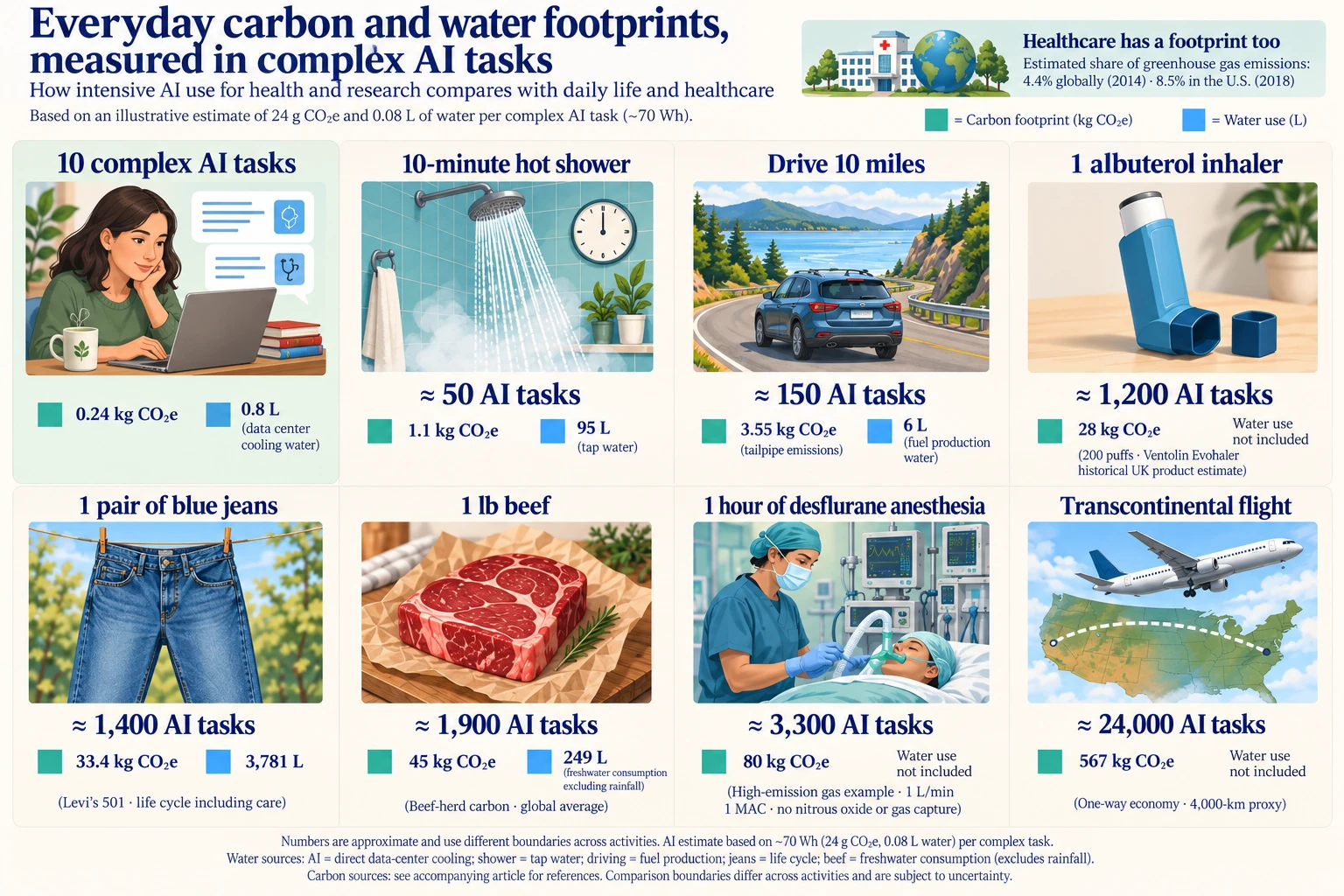
On that assumption, ten complex tasks come to about 0.24 kilograms of carbon dioxide equivalent (CO2e) and about 0.8 liters of water used directly to cool the data center. I’ve included the sources and the calculations in the footnotes. 4[5] The water figure counts cooling only; if you add the water consumed generating the electricity, it’s a few times higher, and it varies a great deal by where the data center sits. It also leaves out model training, hardware manufacturing, and the device in your hand that you’re using to access the model.
Importantly, even complex tasks vary. Very long conversations with hundreds of pages of records attached, or models that spend a long time thinking, may cost more, although a more recent technological improvement called caching can make these models significantly more efficient. 7 To be clear, the numbers also don’t describe what my co-founder and I do all day when we’re spending hours coding improvements to the app. That said, as a bit of context, when the climate scientist Zeke Hausfather metered his own energy use after two months of heavy AI-assisted coding, his thousand prompts came to roughly fifty kilograms of CO2, which comes to about a pound of beef, and a year of that use was extrapolated to about 370 kilograms of CO2. 8 So this is the tech-worker footprint, and it IS tremendously higher than the use of an average person who’s asking about their medication list. At ten complex tasks a week, a year of My Doctor Friend use comes to roughly 12 kilograms, about a thirtieth of that.
Now, the infographic speaks for itself, but I’ll talk through it anyway, because some people would rather read than look at a picture.
A ten-minute hot shower. With an electric water heater and a standard showerhead, about 1.1 kilograms of CO2e, which is about 46 complex AI tasks, and 95 liters of water out of the tap, most of which goes down the drain and back into the system. 9
Driving ten miles. In a car that gets 25 miles to the gallon, about 3.55 kilograms of CO2 out of the tailpipe, or about 150 complex tasks, plus roughly 6 liters of water consumed producing the gasoline. 10
A pair of jeans. Levi’s own life-cycle study of its 501s: 33.4 kilograms of CO2e and 3,781 liters of water per pair, counting the cotton, the factory, and years of washing. That’s about 1,400 complex tasks. 11
A pound of beef. About 45 kilograms of CO2e from dedicated beef herds, or about 1,900 complex tasks. The water is about 249 liters of freshwater per pound, not counting rainfall. The familiar “1,800 gallons per pound” adds rainfall on pasture and a modeled volume for diluting pollution. 12
An albuterol asthma inhaler. Health care has its own footprint, about 4.4 percent of global greenhouse gas emissions and about 8.5 percent of US emissions by the best available estimates. 13 A single 200-dose albuterol inhaler with a hydrofluoroalkane propellant carries roughly 28 kilograms of CO2e, by a UK life-cycle study. 14 That’s about 1,200 complex tasks in a device that fits in your pocket, and it’s a device people need.
An hour of anesthesia. The inhaled anesthetics are themselves greenhouse gases, and desflurane is in a class of its own. One hour of desflurane at a low fresh gas flow of one liter a minute is on the order of 80 kilograms of CO2e, or about 3,300 complex tasks, and published estimates at higher flows run well above that. Sevoflurane, the workhorse agent, is roughly twenty times lower: a few kilograms an hour, comparable to driving about eight miles, or a little over a hundred complex tasks. This is why so many anesthesiologists have been quietly retiring desflurane. 15
A transcontinental flight. One seat, one way, in economy, using the UK government’s factor for a 4,000-kilometer flight with upstream fuel and the extra warming from altitude included: about 567 kilograms of CO2e. 16 That’s about 24,000 complex AI tasks. Put differently, one flight equals more than six years of ten complex tasks every single day. The round trip is thirteen.
I think a big takeaway is that the carbon and water footprint of typical AI use for health is a rounding error compared to things most of us buy or do without a second thought. A year of average use, ten complex tasks a week, comes to roughly 12 kilograms of CO2e, about eleven hot showers, 35 miles of driving, or less than half of one inhaler. Even ten tasks a day, every day, is about 90 kilograms for the year, roughly two pounds of beef or a sixth of one flight. Now again, comparisons like this have limits, especially given some of the unknowns in the measurements. And to be clear, a liter used in the Pacific Northwest is quite different from a liter used in a county that’s chronically stressed by drought. My hope is that this puts the question of individual use in better proportion.
So why all the fuss that AI is destroying the planet?
If the individual cost of using AI is smaller than we think, why do we keep seeing all these stories about data centers, and all this backlash about AI? Well, first, the total isn’t tiny. Berkeley Lab has estimated that US data centers used about 4.4 percent of the country’s electricity in 2023, and that this could rise to as much as 12 percent by 2028. 4 The International Energy Agency expects global data-center demand to roughly double by 2030, with AI the fastest-growing part. 17 Efficiency per prompt has improved enormously (Google reports a 33-fold drop in a single year), and total demand went up anyway, because cheaper computing gets used more. 6 The highest use of energy is not by individuals but by enterprises and companies that are building at tremendous scale. Individual patients who are trying to organize their records are not the ones driving this massive investment in data centers. And of course, there’s far more to the concern about data centers than power consumption and environmental cost. There are questions about land use. There are questions about what this could do to people’s jobs and livelihoods. And there’s the long history of big companies moving into small towns, doing what they want, and not necessarily giving back to the community.
Now, there are a few small habits that can help, and to be clear, I don’t want to make an argument like petroleum companies made when they encouraged people to recycle, because the savings are likely modest. But starting a new conversation when you change topics, on whatever AI platform you use, shortens the context, and therefore the amount of compute, and therefore the amount of power needed to answer your query. If you need a sentence changed in a document the model has produced, ask for just the sentence rather than the entire document again. And save the slow, deep-research modes for the questions that need them, since that’s where most of the compute goes.
Why health AI is different
Every day I read what people are doing with My Doctor Friend, and it’s inspiring. People are using this technology to understand their bodies and their health, and to take control of their destiny in a way that was simply impossible just four years ago. People can understand what their specialists are telling them. Caregivers can feel more confident managing their parents’ health. People are not alone at ten o’clock at night with a symptom that’s making them anxious. And people are arriving at clinic appointments better prepared to have productive conversations with their clinicians. Quite often this means an emergency room visit saved, or an appointment with the right clinician made sooner. Some of the heaviest use we see comes from people who are in the hospital, asking the questions that come up during the long hours between rounds. It is dramatic how this technology changes how people relate to their own health when they’re experiencing serious illness. Something shifts in how they relate to themselves and to the people treating them. They stop being an audience for their care and start operating it, which is what I’ve called patient-operated healthcare. 18 And as the infographic above suggests, there are likely significant environmental savings here too. An avoided ER visit, a duplicate scan that’s not ordered, a hospital day that’s avoided: all of these carry water and carbon footprints that dwarf those of a few dozen complex AI tasks.
So my parting message to anyone interested in health AI and worried about the environment: I think you can worry a little less about using AI for your health. You can, at the same time, still hold worries about AI that have nothing to do with the environment or your personal use. And I strongly encourage anyone worried about lax oversight to talk to their local, state, and federal representatives and push hard for better oversight of this potentially dangerous technology, and for real multilateral international cooperation. And to vote.
References & Further Reading
[1] Center for AI Safety, Statement on AI Risk, May 30, 2023: “Mitigating the risk of extinction from AI should be a global priority alongside other societal-scale risks such as pandemics and nuclear war.” Signatories include Geoffrey Hinton, Yoshua Bengio, and the heads of OpenAI, Google DeepMind, and Anthropic.
[2] Center for AI Safety, Statement on AI Risk, May 30, 2023: “Mitigating the risk of extinction from AI should be a global priority alongside other societal-scale risks such as pandemics and nuclear war.” Signatories include Geoffrey Hinton, Yoshua Bengio, and the heads of OpenAI, Google DeepMind, and Anthropic.
[3] The simple-query baseline. Sam Altman, “The Gentle Singularity,” June 10, 2025: an average ChatGPT query uses about 0.34 watt-hours of electricity, stated without a method. Google’s measured median Gemini text prompt (May 2025) was 0.24 Wh 6, and independent estimates for a short answer run from about 0.3 to 0.84 Wh (Epoch AI, February 2025; Jegham et al., 2025). Hausfather calls these ordinary-chat figures “basically right” 8; the problem is that they describe one short exchange, not a task.
https://blog.samaltman.com/the-gentle-singularity
https://epoch.ai/gradient-updates/how-much-energy-does-chatgpt-use
https://arxiv.org/abs/2505.09598
[4] The complex-task assumption and the carbon conversion. I assume about 70 Wh per complex task, roughly 200 times the 0.34 Wh simple-query figure. For context: Hausfather’s own heavy coding use came to about 150 Wh per prompt (range 60 to 290) 8; the Watershed framework he cites puts agentic workflows of 5 to 50 model calls at roughly 50 to 500 Wh; Oviedo et al. (Joule, 2026) put a typical frontier request near 0.34 Wh and a long reasoning answer at about 13 times that; Anthropic says its Research feature commonly makes five or more tool calls and that its multi-agent research system uses about 15 times the tokens of ordinary chat. Carbon uses Berkeley Lab’s US data-center electricity factor of 0.34 kg CO2e per kWh (2024 United States Data Center Energy Usage Report, pp. 55 to 57): 0.07 kWh x 0.34 = 0.024 kg per task, so 10 tasks = 0.24 kg CO2e, 520 tasks (ten a week for a year) = 12.5 kg, and 3,650 tasks (ten a day) = 88 kg. The same report puts US data centers at 176 TWh and 4.4 percent of US electricity in 2023, with 6.7 to 12 percent projected for 2028.
https://arxiv.org/abs/2509.20241
https://www.anthropic.com/engineering/multi-agent-research-system
https://openai.com/index/introducing-deep-research/
[5] Water. The 0.8 liters per 10 tasks is direct data-center cooling water only: Google reports a fleetwide water-use effectiveness of about 1.15 liters per kWh, so 0.7 kWh x 1.15 = 0.8 L. Microsoft reports a lower fleetwide figure of about 0.27 L/kWh, which shows how much this depends on the site. Adding the water consumed generating the electricity (Berkeley Lab’s 4.52 L/kWh) would bring the 10-task total to roughly 4 liters.
https://datacenters.microsoft.com/sustainability/efficiency/
[6] Google’s figure. Elsworth et al. (Google), “Measuring the environmental impact of delivering AI at Google Scale,” August 2025: the median Gemini Apps text prompt in May 2025 used 0.24 Wh, emitted 0.03 g CO2e, and consumed 0.26 mL (about five drops) of cooling water, which Google compares to under nine seconds of television. Google’s carbon figure uses market-based electricity accounting (it counts the company’s renewable-energy contracts). Google also reports 33-fold energy and 44-fold carbon reductions per median prompt over the prior twelve months.
https://arxiv.org/abs/2508.15734
[7] On caching and long conversations: OpenAI and Anthropic prompt-caching documentation, and Epoch AI’s September 2026 measurement of how response latency scales with context length.
https://developers.openai.com/api/docs/guides/prompt-caching
https://platform.claude.com/docs/en/build-with-claude/prompt-caching
https://epoch.ai/publications/long-context-latency-scaling-gpt-vs-claude
[8] Zeke Hausfather, “The real energy use of agentic AI,” The Climate Brink, August 5, 2026. Eight weeks of Claude Code use: 1,138 prompts, about 14,000 model calls, about 170 kWh (range 70 to 330), roughly 150 Wh per prompt, and about 370 kg CO2e per year on the US-average grid.
[9] Shower: US EPA puts a standard showerhead at 2.5 gallons per minute, so 25 gallons (94.6 L) in ten minutes. Heating that water from 15 to 40 degrees C at 90 percent efficiency takes about 3.06 kWh; at Berkeley Lab’s US-overall factor of 0.35 kg CO2e per kWh, that’s about 1.07 kg, shown as 1.1 kg. The water figure is tap water delivered, not net consumption.
https://www.epa.gov/watersense/showerheads
[10] Driving: US EPA, 8,887 grams of CO2 per gallon of gasoline, so 0.4 gallons for ten miles at 25 mpg gives 3.55 kg, tailpipe only. Water: Argonne National Laboratory’s estimates of water consumed producing petroleum gasoline range from about 1.4 to 8.6 gallons per gallon of fuel depending on the crude source, or roughly 2 to 13 liters for this drive; about 6 liters is a mid-range value.
https://www.epa.gov/greenvehicles/greenhouse-gas-emissions-typical-passenger-vehicle
https://water.es.anl.gov/documents/ANL_ESD_09-1_Update%202018.pdf
[11] Levi Strauss & Co., “The Life Cycle of a Jean,” 2015 (pp. 17 and 47).
https://www.levistrauss.com/wp-content/uploads/2015/03/Full-LCA-Results-Deck-FINAL.pdf
[12] Beef carbon: Poore and Nemecek, “Reducing food’s environmental impacts through producers and consumers,” Science, 2018; 99.48 kg CO2e per kg of beef from beef herds, retail weight, from the authors’ Data S2. Beef from dairy herds is about a third of that. Beef water: Mekonnen and Hoekstra, “The green, blue and grey water footprint of farm animals and animal products,” 2010, Table 6; 550 liters of blue water (surface and groundwater consumed) and 15,415 liters total per kg once rainfall and pollution dilution are included.
https://pubmed.ncbi.nlm.nih.gov/29853680/
https://josephpoore.com/data/science2018/Data%20S2.xls
https://www.waterfootprint.org/resources/Report-48-WaterFootprint-AnimalProducts-Vol1.pdf
[13] Health Care Without Harm and Arup, “Health Care’s Climate Footprint,” 2019 (4.4 percent of global net emissions, 2014 data); Eckelman et al., “Health Care Pollution and Public Health Damage in the United States: An Update,” Health Affairs, December 2020 (8.5 percent of US emissions, 2018).
https://global.noharm.org/resources/health-care-climate-footprint-report
https://www.healthaffairs.org/doi/10.1377/hlthaff.2020.01247
[14] Wilkinson et al., “Costs of switching to low global warming potential inhalers,” BMJ Open, 2019; about 28 kg CO2e for a 200-dose Ventolin Evohaler. Other albuterol inhalers can be much lower, around 10 kg for some small-volume products.
https://pmc.ncbi.nlm.nih.gov/articles/PMC6830591/
[15] Anesthesia. Sherman, Le, Lamers, and Eckelman, “Life Cycle Greenhouse Gas Emissions of Anesthetic Drugs,” Anesthesia & Analgesia, 2012, finds desflurane’s life-cycle emissions about 20 times sevoflurane’s per MAC-hour with an oxygen/air carrier, dominated by the vented gas itself (desflurane’s 100-year warming potential is 2,540 times CO2; sevoflurane’s is 130). At one MAC and a 1 L/min fresh gas flow, an hour vents roughly 28 g of desflurane, about 70 kg CO2e before the rest of the life cycle; the infographic’s 80 kg is an illustrative low-flow estimate, and published figures at higher flows run from about 88 to 163 kg per hour. Sevoflurane at 2 L/min works out to a few kilograms an hour; clinical sources compare an hour of desflurane at high flow to driving more than 300 miles and an hour of sevoflurane to about eight.
https://doi.org/10.1213/ANE.0b013e31824f6940
[16] UK Department for Energy Security and Net Zero, Greenhouse Gas Reporting: Conversion Factors 2026. Long-haul economy factor with the radiative-forcing adjustment plus upstream fuel, applied to 4,000 km: 566.6 kg CO2e one way.
https://www.gov.uk/government/publications/greenhouse-gas-reporting-conversion-factors-2026
[17] International Energy Agency, Energy and AI, 2025. Data centers at about 415 TWh (1.5 percent of global electricity) in 2024, projected to about 945 TWh (just under 3 percent) in 2030.
https://www.iea.org/reports/energy-and-ai/energy-demand-from-ai
[18] Michael Turken, “The ‘AI Doctor’ is healthcare’s ‘horseless carriage,’” Sovereign Care, May 10, 2026.
The "AI Doctor" is healthcare's "horseless carriage."
Robert Wachter has talked many times about the productivity paradox: new technologies that promise to increase efficiency often take years to deliver on their promise.
Originally published on Sovereign Care on Substack.